
More of your customers are asking an AI which business to call. They type "who's a good electrician near me" into ChatGPT or Google, and a short answer names a few businesses. We see this shift in nearly every market we look at — and most local owners have no idea whether they're in those answers or not. The short version: there's no secret AI button. You show up in AI search by doing solid, normal SEO, structuring your content so it's easy to quote, and being mentioned in enough places that the AI trusts you. Here's how that works.
1AI search is already where your customers are
This isn't a someday thing. It's happening now.
Google's AI Overviews — the AI summary at the top of a search — had over 2 billion monthly users as of mid-2025 (Alphabet, reported July 2025). ChatGPT hit 800 million weekly active users by October 2025 (Sam Altman). These are not niche tools anymore.
And people use them to find local businesses. 45% of US consumers used AI tools for local business recommendations in 2026, up from 6% the year before — now the third most-used tool behind Google and Facebook (BrightLocal, 2026). At Bare Bayside Labs, we're already seeing AI answers decide who gets the first call, especially for "near me" and "how much does X cost" searches.
2Why this matters even if you rank on Google
You might rank well in normal search and still be invisible in the AI answer sitting above it.
That's a problem because of zero-click search. In 2024, for every 1,000 US Google searches, only about 360 clicks reached the open web — roughly 58.5% of searches ended without a click (SparkToro). A 2026 update puts that figure even higher. People read the AI answer and stop.
So if the AI names three competitors and not you, you don't just lose a ranking. You lose the click entirely.
3The big myth: there's no special "AI markup" to add
Before you spend money on anything, hear this clearly.
Google has stated plainly that you don't need to create new machine-readable files, AI text files, or special markup to appear in AI features. There's no required schema.org data and "no additional requirements" (Google Search Central, AI Features and Your Website).
You may have heard about llms.txt — a proposed file that's supposed to feed AI engines. As of 2026 the major AI engines don't consume it. It's not a live edge. Don't let anyone sell you one.
The real requirement is simpler: your page has to be indexed and eligible to show with a snippet. If Google can find it and show a short preview of it, it's in the running. If it can't, no amount of clever formatting helps.
4GEO is still SEO
You'll see the term "GEO" — Generative Engine Optimisation. It sounds like a whole new discipline. It mostly isn't.
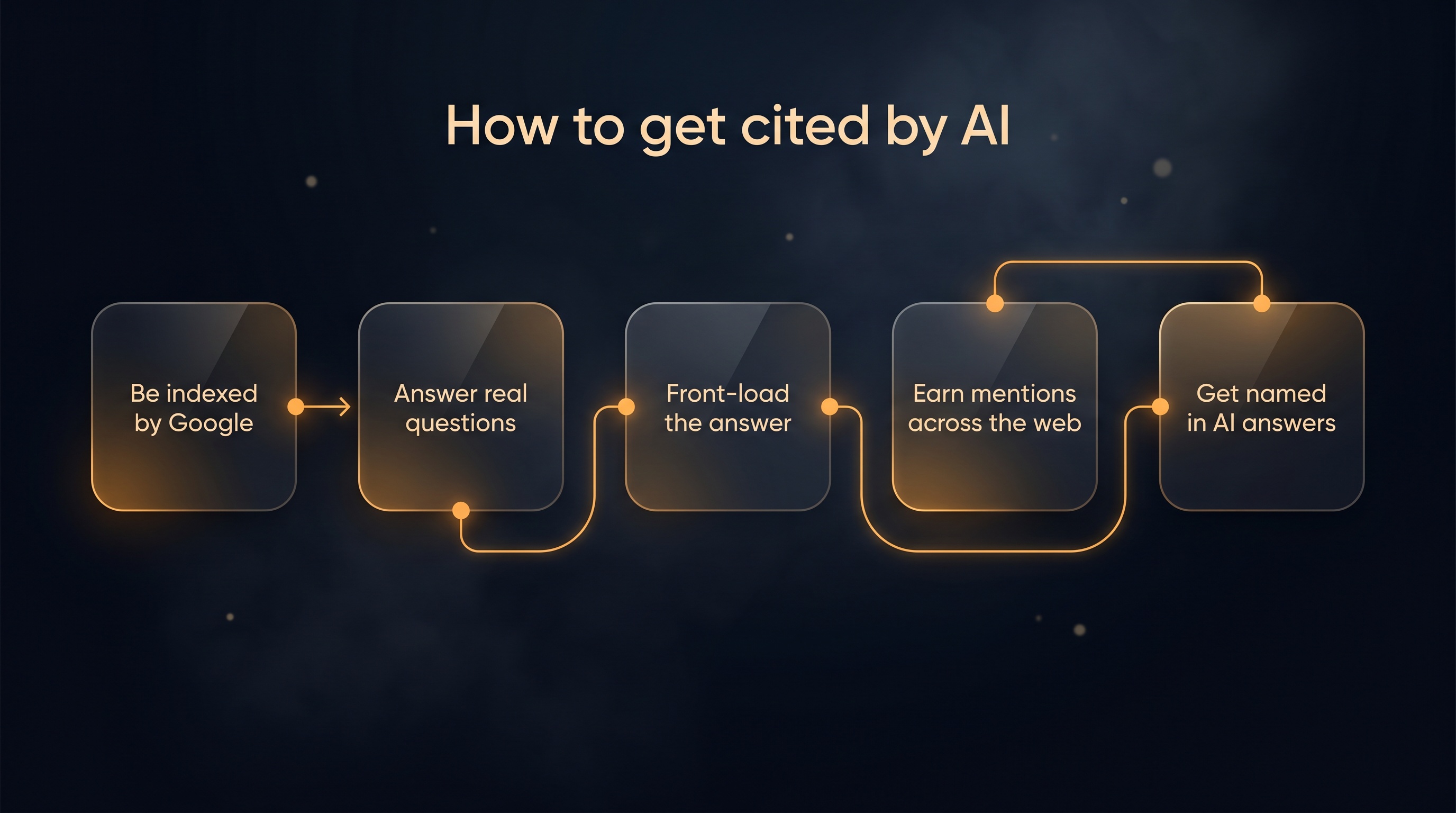
Getting cited by AI runs on the same foundations as ranking on Google: useful pages, clear structure, a properly indexed site, and a trusted reputation across the web. The AI is reading the same content. So the work below is good SEO that happens to make you very quotable.
If you nail the fundamentals, you're already most of the way to showing up in AI answers. Here's where to put your effort.
5Step 1: Make sure you can actually be found and indexed
None of this works if the AI can't read your site.
- Your important pages must be live, public, and not blocked from search engines.
- Don't hide your best content behind a contact form or login. A page locked behind a wall is invisible to AI tools.
- Make sure your site loads and works on a phone. Slow, broken pages get crawled less.
This is the boring part, and it's the part most worth checking first. A beautifully written answer the AI can't reach earns nothing.
6Step 2: Structure content as questions and answers
AI tools don't quote whole pages. They lift short, self-contained passages that cleanly answer a specific question.
So write that way:
- Use the real question as a heading. "How much does a standard service cost?" beats "Our Pricing." Use the words a person would actually type or say.
- Front-load the answer. The first sentence under the heading gives the answer. Detail comes after. No throat-clearing.
- Keep answers to two to four sentences. If a question needs more, split it into two questions. Short, dense answers get extracted more reliably.
- Use lists and clear headings. Bullet points and plain H2/H3 structure are easy for a machine to parse.
An analysis of around 8,000 AI citations found that 82.5% pointed to deeply nested, content-rich pages — not homepages (Search Engine Land). The lesson: build real, specific answer pages, not one shallow catch-all.
7Step 3: Include specific facts and numbers
AI engines favour content that states things concretely. Vague pages get skipped.
A Princeton study on Generative Engine Optimisation found that adding citations and statistics to a page can lift its visibility in AI answers by roughly 40% (arXiv "GEO" study). You don't need to fake data — use real specifics about your work: how long a job takes, what's included, where you operate, what a typical price range looks like.
Specific beats generic every time. "Most standard call-outs are completed in two to three hours" is quotable. "We're fast and reliable" is not.
8Step 4: Build off-site mentions and reputation
This is the half most local owners skip — and it's where a lot of the trust comes from.
AI engines don't just read your website. They weigh up what the wider web says about you: directories, review platforms, local media, industry sites, social profiles. When several independent sources say consistent things about your business, the AI treats that as a reliable signal.
So the work is:
- Keep your name, address, and phone number identical everywhere they appear.
- Maintain real listings on the major directories for your trade and region.
- Earn genuine mentions — a supplier's partner page, a local news piece, an industry directory.
Our companion guide, The Mentions That Make AI Trust a Local Business, goes deep on the off-site half.
9Step 5: Keep reviews healthy
Reviews feed both the decision and the trust signal, especially for Google's AI, which surfaces review data directly.
The behaviour is striking: 97% of people read reviews, 68% will only use a business with 4+ stars, and 74% want to see reviews from the last three months (BrightLocal, 2026). Recent, steady reviews matter more than a big pile of old ones. Keep them coming in rather than chasing a one-time total.
10What about schema markup?
Schema is structured data you can add to a page to help machines understand it. It's worth doing — but be clear on what it does.
Schema makes a page eligible for rich results and helps search engines understand your content. It is not a ranking factor, and Google has confirmed it isn't required for AI features either. Think of it as clarity, not magic. If you want the plain-English version, read What Is Schema Markup?.
11Where the on-site answers page fits
Steps 2 and 3 above come together in one concrete asset: a dedicated questions-and-answers page on your own site. That's a specific build, and it's worth its own walkthrough — see Building an Answers Page AI Will Quote. This article is the wider strategy; that one is the page you build to execute part of it.
Key takeaways
- There's no secret AI markup. Google says you don't need special files or schema to appear in AI features — you need to be indexed and eligible to show with a snippet.
- GEO is still SEO. Useful, well-structured, well-indexed pages with a trusted reputation are what get quoted. The fundamentals carry over.
- Structure content as question-and-answer passages. Real question as heading, answer in the first sentence, two to four sentences each — that's the format AI tools extract.
- Deep, specific pages win. About 82.5% of AI citations went to deeply nested content-rich pages, not homepages (Search Engine Land).
- Specifics lift visibility. Adding real facts and statistics can raise a page's AI visibility by around 40% (Princeton GEO study).
- Off-site mentions and recent reviews build the trust that decides whether the AI names you at all.
Common questions
Do I need to pay for a special tool to show up in AI search?
No. Google has confirmed there's no special file, markup, or schema required to appear in AI features. The work is normal SEO done well: useful pages, clear structure, a properly indexed site, and a trusted off-site reputation. Be wary of anyone selling a shortcut.
How is this different from regular SEO?
It mostly isn't. AI engines read the same web. The extra emphasis is on structuring content as clean question-and-answer passages, front-loading your answers, and including specific facts — because AI tools quote short passages rather than ranking whole pages.
How long until I show up in AI answers?
It depends on your reviews, your off-site mentions, and how competitive your area is. A business with solid recent reviews and a few web mentions can start appearing in weeks. Starting from scratch takes longer, because the trust signals take time to build.
Does schema markup get me cited by AI?
It helps machines understand your page and makes you eligible for rich results, but it's not required for AI features and it's not a ranking factor. Treat it as clarity that supports good content, not as a way to force citations.
Should I focus on ChatGPT, Google AI, or Perplexity?
Do the foundations once and you cover all of them — they reward the same things: clear, useful, well-indexed content and a consistent off-site presence. The main split is that Google's AI leans on your Google Business Profile and Google reviews, while ChatGPT leans more on the wider web, so keep your listings and details consistent everywhere.
Related articles
Want to see which AI answers your local competitors are already showing up in — and where the gaps are?
Get a free competitor snapshot — we show you where rivals show up online and where the gaps are.
Get your free snapshot→