
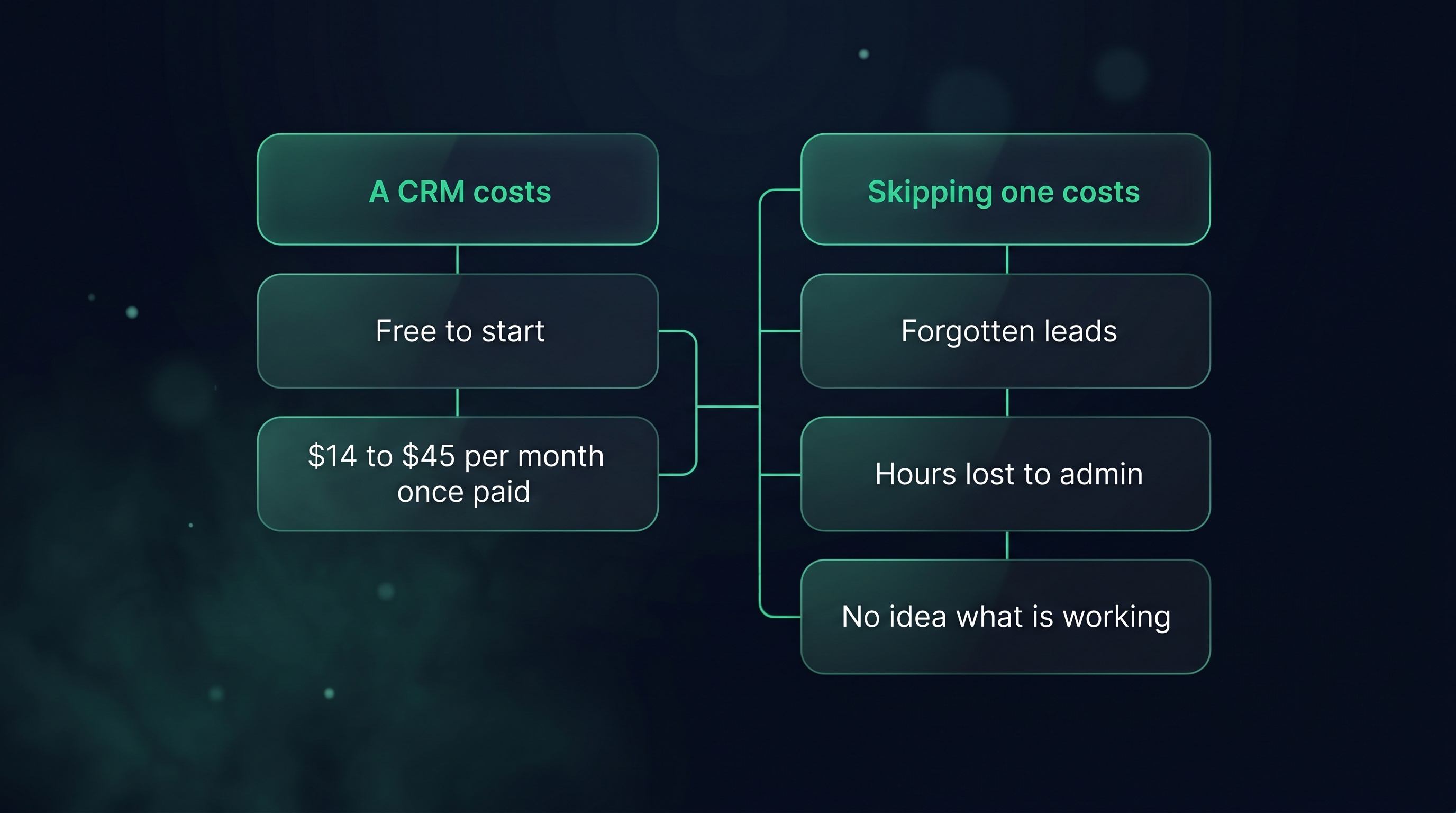
You've heard a CRM would help, but you assume it's expensive enterprise software you can't justify. We hear that worry from almost every owner we talk to — and it's usually backwards. The honest answer: a CRM for a small business is free to start and roughly $14 to $45 a month once you're paying, billed annually in USD. The bigger number is what skipping one quietly costs you in forgotten leads and admin time. Let's put both sides on the table.
1What a CRM costs at the low end: nothing
You can run a real CRM for $0 while you learn the habit.
- HubSpot has a genuinely free CRM tier covering basic contact and deal tracking.
- Zoho CRM has a free plan for a small team with the basics.
These are limited — you'll outgrow them once you want proper automation and reporting — but they're a legitimate place to start. Don't pay for software before you've proven you'll actually use it.
2What a CRM costs once you're paying
Here's the real market, in USD, billed annually. Prices vary by region and billing terms, so treat these as the ballpark, not a fixed global rate.
- Zoho CRM — Standard around $14/user/mo; Professional around $23/user/mo.
- Pipedrive — Lite around $14/seat/mo, up to Ultimate around $79/seat/mo.
- HubSpot — Free to start; Starter around $15–20/seat/mo; Professional starts around $100/seat/mo.
- Salesforce — Starter around $25/user/mo; Pro around $100/user/mo.
For a one-person or small local business, the entry tier of Zoho or Pipedrive — roughly $14 a month — covers what you need: contacts, pipeline stages, and follow-up automation.
3When you want more than a CRM
If you also need email marketing, web forms, and analytics, look at a bundle rather than stitching tools together.
Zoho One is around $37/employee/mo on the all-employee plan, or about $90/user on the flexible plan (USD, annual). That gets you the CRM plus marketing automation, forms, analytics, and dozens of other apps in one place. For a small business that would otherwise pay for three or four separate subscriptions, a bundle often works out cheaper overall.
So the realistic spread for a small local business is $0 to start, $14–45/mo for a solid paid setup, more only if you deliberately add an enterprise platform.
4The cost that doesn't show up on an invoice
Here's the part most owners miss. The subscription isn't the real cost decision — the cost of not having a system is.
Think about where your week actually goes. Sales reps spend only 28% of their time actually selling; the rest is admin, data entry, meetings, and chasing information (Salesforce State of Sales, 2023). For an owner running everything, that admin tax is even heavier — and it's invisible because no one invoices you for it.
At Bare Bayside Labs, we see this in nearly every business we audit: the leads come in, but nobody's chasing them, and nobody can say which marketing brought them. That's not a software problem. It's the cost of having no system.
5The cost of leads you forget
The most expensive thing about skipping a CRM is the work you already paid to attract and then lost.
Industry research has long suggested that roughly four in five leads never convert without nurturing — they go quiet, you get busy, and the follow-up never happens. A CRM's whole job is to stop that: every enquiry gets a record and a status, and follow-ups fire on a schedule whether or not you remember.
We see the turning point hit when manual tracking starts dropping leads — that's the moment the monthly fee becomes the cheapest line in the business.
6Does the maths actually work?
It tends to, even on conservative numbers.
A widely cited figure puts CRM return at $8.71 for every dollar spent (Nucleus Research, 2014 — worth flagging the year, and Nucleus's more recent estimate is closer to $3.10 per dollar). Either way, the direction is the same: a system that recovers even one or two jobs a month a busy owner would otherwise have dropped pays for a $14–45 subscription many times over.
The catch is the same one from our main CRM guide: the return only shows up if the CRM is actually set up and used. A half-finished CRM is just another bill.
7The real cost is leaving it half-built
This is where the money is won or lost.
A CRM configured once — forms connected, follow-up emails written, pipeline stages defined — pays for itself fast. A CRM that sits half-set-up does nothing but charge you. The subscription is the small number. The setup effort is what determines whether you ever see the return.
If you're weighing a CRM against a spreadsheet on cost grounds specifically, CRM vs Spreadsheet draws the line clearly.
Key takeaways
- A CRM is free to start. HubSpot and Zoho both have genuine free tiers — enough to build the habit before you spend anything.
- Paid plans are $14–45/mo for a small business, billed annually in USD, with prices varying by region. The entry tier of Zoho or Pipedrive covers most local businesses.
- A bundle can be cheaper than separate tools. Zoho One (around $37/employee/mo) folds CRM, email, forms, and analytics into one subscription.
- The invisible cost is your time. Reps spend only 28% of their week selling; for owners the admin tax is heavier still (Salesforce, 2023).
- The biggest cost is forgotten leads — work you already paid to attract. Roughly four in five leads never convert without nurturing.
- The real waste is a half-built CRM. Set it up properly once and it pays for itself; leave it half-finished and it's just another bill.
Common questions
What's the cheapest way to start with a CRM?
Free. Both HubSpot and Zoho CRM have free tiers that cover basic contact and deal tracking. Start there, build the habit of logging every lead, and only move to a paid plan once you need automation and reporting — usually within a few months.
How much should a small business expect to pay?
For a solid paid setup, roughly $14–45 a month, billed annually in USD, with prices varying by region. The entry tiers of Zoho CRM or Pipedrive sit around $14/user/mo. If you also want email marketing and forms, a bundle like Zoho One (around $37/employee/mo) is often better value than buying tools separately.
Is a CRM really worth the cost for a small business?
If you're losing track of leads or can't tell which marketing works, yes. The subscription is small next to the cost of forgotten enquiries and admin time. A frequently cited estimate puts CRM return at $8.71 per dollar spent (Nucleus Research, 2014), though more recent figures are lower — the point is the return dwarfs the fee when the system is used.
Why do some CRMs cost so much more than others?
Entry tiers cover the basics. Prices climb steeply once you add advanced automation, large teams, or enterprise features. HubSpot and Salesforce Professional plans start around $100/seat/mo. A small local business rarely needs that — match the plan to what you'll actually use.
What's the hidden cost people forget?
Setup. The subscription is the small number; the work to configure forms, write follow-up emails, and define pipeline stages is what determines whether you ever see a return. A half-finished CRM costs you the fee and delivers nothing.
Related articles
Want to see how much unfollowed-up work is already sitting in your business?
Get a free competitor snapshot — we show you where rivals show up online and where the gaps are.
Get your free snapshot→