
You've heard you should "automate your emails," but then you hit two words that sound like the same thing — drip and triggered — and you're not sure which one you actually need. We hear this a lot. The short answer: a drip campaign is a scheduled sequence everyone on a list moves through, while a triggered email fires the instant a specific person does a specific thing. Most local businesses end up using both, for different jobs. Here's how to tell them apart and pick the right one.
1What a drip campaign is
A drip campaign is a fixed sequence of emails sent on a schedule once someone joins it.
Think of it like a slow tap. Someone signs up, and the emails "drip" out at set intervals — day one, day three, day seven — regardless of what that person does. Everyone who enters the sequence gets the same messages in the same order, paced by the calendar.
A welcome series is a classic drip. So is a five-email follow-up sequence after an enquiry. The timing is built around when someone entered, not around any later action they take.
2What a triggered email is
A triggered email fires in response to a specific action by a specific person.
The action is the trigger. Someone clicks a link, books a call, abandons a form, hits a certain page, or doesn't open three emails in a row — and that exact event sends an email tailored to it. It's reactive, not scheduled.
The instant confirmation a customer gets the second they submit your form? That's triggered. It didn't wait for a clock — it responded to what they just did.
3The simplest way to tell them apart
Here's the one-line test: a drip is paced by time; a trigger is paced by behaviour.
If the email goes out because three days passed, it's drip. If it goes out because the person did something, it's triggered.
In practice the line blurs, because most drip sequences are kicked off by a trigger (joining the list) and most automation tools let you mix the two. But the distinction still helps you decide what to build.
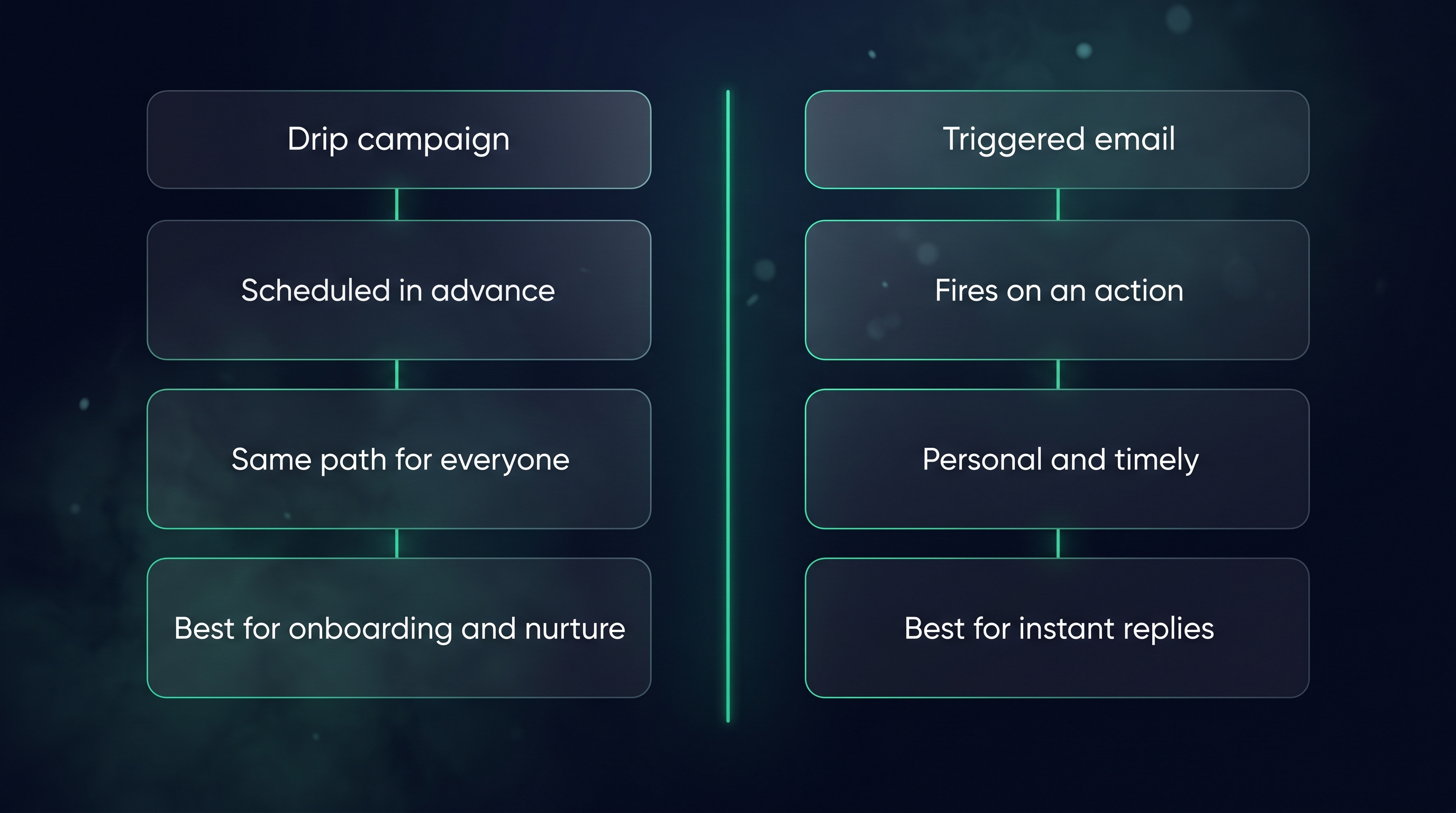
4Drip vs triggered: side by side
| Drip campaign | Triggered email | |
|---|---|---|
| What sets it off | Someone joins the sequence | A specific action (click, booking, page visit, no-reply) |
| Paced by | The calendar — fixed intervals | The person's behaviour — real time |
| Same for everyone? | Yes, same messages, same order | No, tailored to the action taken |
| Feels | Planned, steady | Timely, responsive |
| Best for | Welcome series, education, long nurture, re-engagement | Instant replies, confirmations, abandoned forms, win-backs |
| Main risk | Can feel generic or mistimed for the individual | Needs the right events tracked, or it never fires |
| Effort to set up | Lower — write once, schedule | Higher — define and track each trigger |
5When a drip campaign is the right call
Reach for a drip when the content matters more than the moment.
Drips shine when you have a set of things you want everyone to learn or receive over time, and the exact timing isn't critical to each person. A welcome series teaching new leads how you work. A multi-step follow-up after an enquiry. A slow "stay in touch" nurture for people who aren't ready yet.
Welcome emails average an 83.6% open rate across billions of emails — far above a typical campaign (GetResponse Email Marketing Benchmarks, 2024). At Bare Bayside Labs, we see the welcome message do a lot of quiet heavy lifting — it's the email people actually read, so it's worth getting right whether it's the first step of a drip or a standalone trigger.
Drips are also the easier of the two to build. You write the emails once, set the intervals, and let people flow through.
6When a triggered email is the right call
Reach for a trigger when the moment is the whole point.
Triggered emails win when responding right now changes the outcome. The classic is speed-to-lead: an instant reply the second someone enquires. Confirmations, booking reminders, a nudge when someone started a form but didn't finish, a win-back when a past customer goes quiet — all triggered, because the timing is the value.
Across ecommerce senders, automated emails drove 41% of all email orders from just about 2% of sends, converting at 1.76% versus 0.07% for one-off campaigns (Omnisend, 2024). At Bare Bayside Labs, this is the pattern we point to when someone doubts automation is worth it — the right message at the right moment does the heavy lifting, not the big blast.
If you only set up one automation ever, make it a triggered instant reply to new enquiries.
7What we recommend
Don't pick a side — use both, for the jobs each is good at.
A practical setup for most local businesses looks like this: a triggered instant confirmation the moment an enquiry lands, then a short drip that follows over the next two weeks (helpful note, social proof, check-in, last call), with a couple of triggered exits layered on top — stop the drip the moment someone replies or books.
That combination gives you the speed of a trigger where it counts and the steadiness of a drip everywhere else. For the actual emails to put in that follow-up sequence, see The 5 Follow-Up Emails Every Local Business Should Automate, and for wiring it all up, How to Automate Your Follow-Up Emails.
Key takeaways
- Drip is paced by time; triggered is paced by behaviour. That's the one test that settles almost every "which is this?" question.
- A drip campaign sends the same scheduled sequence to everyone who enters it — great for welcome series and long nurtures.
- A triggered email fires on a specific action — great for instant replies, confirmations, and win-backs where timing is everything.
- Drips are easier to build; triggers need the right events tracked but respond in the moment.
- Most businesses should use both — a triggered instant reply plus a short follow-up drip, with triggered exits to stop the drip when someone replies.
Common questions
Is a welcome email a drip or a triggered email?
A single welcome email is technically triggered — it fires the moment someone joins. A welcome series of several emails over a few days is a drip. In everyday terms, people call the whole thing a welcome drip, and that's fine.
Which one should I set up first?
The triggered instant reply to new enquiries. Responding fast is where most jobs are won or lost, so that single automation usually pays off before a longer drip does.
Can one sequence be both?
Yes, and most good ones are. A sequence is often kicked off by a trigger (someone enquires), runs as a timed drip, and uses more triggers to branch or stop it (someone replies, so the rest pauses). The labels describe parts of a system, not rival products.
Do I need expensive software for triggered emails?
Not necessarily, but triggered emails depend on your tool being able to detect actions — a click, a booking, a form abandon. Most CRMs and the better email platforms handle the common triggers. The more unusual the trigger, the more capable the tool needs to be.
Won't a drip campaign feel impersonal?
It can if it's generic or badly timed for the individual — that's its main weakness. You soften it by writing like a person, keeping it short, and adding triggered exits so people who've already converted stop receiving it.
Related articles
Want to see how your email and follow-up game compares to the businesses you're up against?
Get a free competitor snapshot — we show you where rivals show up online and where the gaps are.
Get your free snapshot→