
You know you should follow up with every enquiry, but writing a fresh email each time never happens — you're on a job. The fix is to write five emails once, then let them send themselves on a schedule. Below are the five every local business needs, with paste-ready copy and the timing for each. Change the brackets, switch them on, and never start from a blank screen again.
This is the copy. If you want the system that sends it, How to Stop Losing Leads covers the build, and How to Automate Your Follow-Up Emails walks through the setup on any platform.
1Why five emails, and why automate them
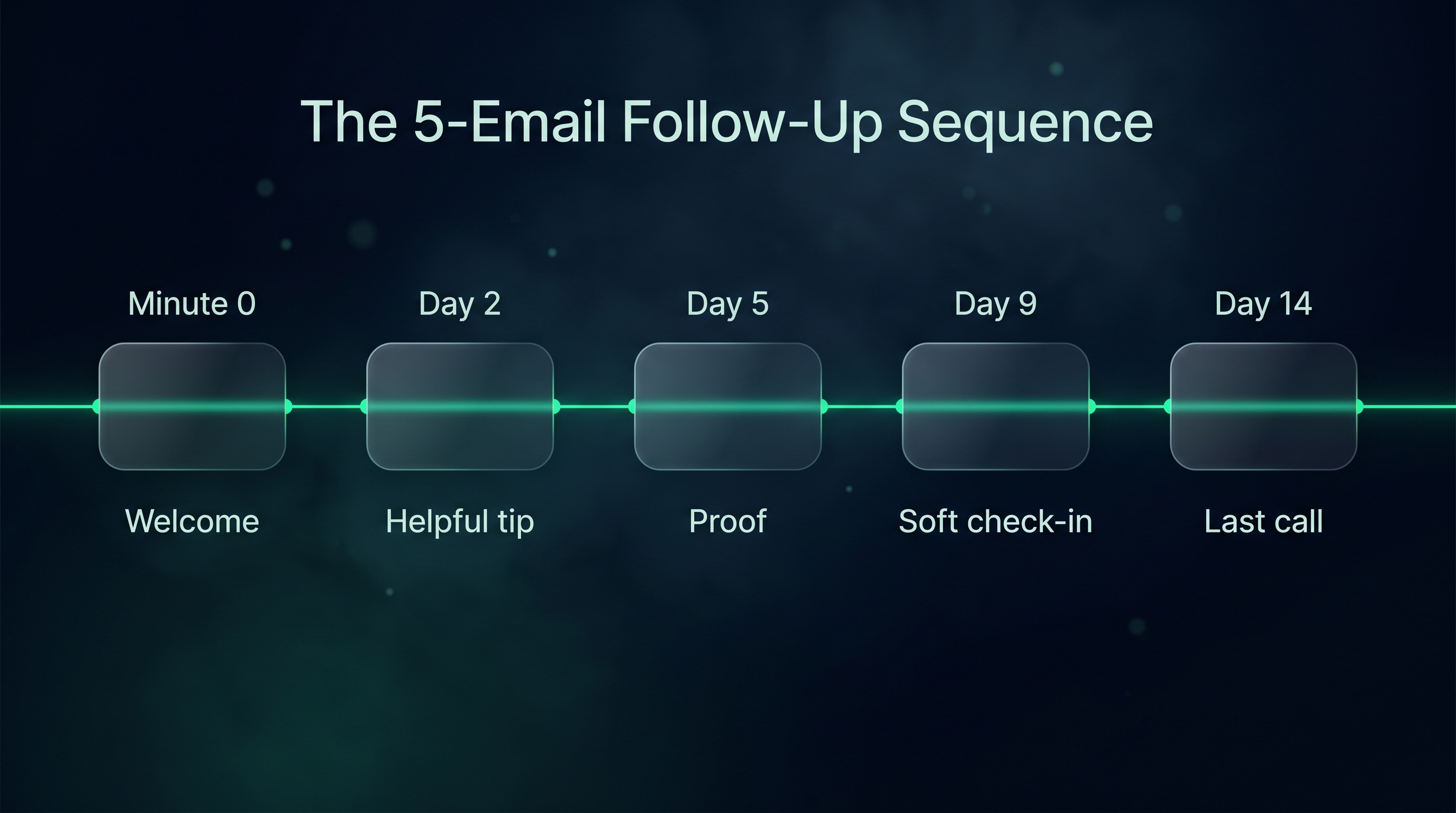
One follow-up isn't enough, and ten is too many. Five spread over a couple of weeks keeps you top of mind without becoming a pest.
A commonly cited sales figure suggests around 80% of sales require five follow-ups, yet 44% of reps give up after one — The Brevet Group. The exact figures get debated, but the pattern matches what we see across nearly every local business: people stop chasing far too early and write off leads that were still warm.
Automating them matters because manual follow-up is the first thing to slip when you're busy — and across ecommerce senders, automated emails drove 41% of all email orders from only about 2% of sends (Omnisend, 2024). The principle carries over: a small number of well-timed automatic emails does a disproportionate amount of the work.
2Before you copy: three rules that make these work
These templates only work if you keep them human. Three quick rules.
Write like you talk. Short sentences. First names. No "we leverage solutions." If you wouldn't say it to someone standing in front of you, cut it.
Fill in every bracket. The [brackets] are placeholders. An email that still says [their name] when it sends does more harm than no email at all.
Always have a stop condition. The moment someone replies or books, the rest of the sequence must stop. Getting a "still thinking about it?" email after you've already spoken is the fastest way to look amateur.
3Email 1 — The instant confirmation (sends immediately)
This goes out the second someone enquires. It's the most important email in the sequence because it's the one people actually expect — and the one most businesses never send.
Welcome and confirmation emails are the most-opened emails there are. Welcome emails average an 83.6% open rate (GetResponse, 2024), which means almost everyone reads this one. Make it count.
Timing: Immediately on enquiry. Subject: Got your message — here's what happens next
Hi [first name], Thanks for getting in touch about [their enquiry — e.g. "your blocked drain" or "a quote for the back deck"]. This is just to confirm it landed with us. I'll personally be in touch within [your real window — e.g. "the next couple of hours"] to talk through the details. If it's urgent, you can reach me directly on [phone]. Talk soon, [Your name] [Business name]
Notice it promises a real follow-up window — and then you have to keep it. That's what the next email is for.
4Email 2 — The personal nudge (a few hours later, if you haven't connected)
This one only sends if you haven't already spoken to them. It's a gentle check that nothing got lost, and it reinforces that a real person is on the case.
Timing: 2–4 hours after enquiry, only if there's been no reply or call connected. Subject: Did my message reach you?
Hi [first name], Just making sure my note came through — sometimes these end up in spam. I'd love to help with [their enquiry]. What's the best time and number to reach you? Happy to call when it suits, or you can grab me on [phone] any time today. Cheers, [Your name]
Keep it light. The goal is to open a conversation, not to pitch. If they reply here, the sequence stops and you take it from there.
5Email 3 — The value email (around day 2)
By now some people have gone quiet. Don't chase — give them something useful instead. This email proves you know your trade without asking for anything.
The content depends on what you do. A few ideas:
- A short "what to expect" guide for the kind of job they asked about.
- A simple checklist that helps them prepare.
- One genuinely useful tip that saves them time, money, or hassle.
Timing: ~2 days after enquiry. Subject: A quick guide while you decide on [their job]
Hi [first name], No rush on getting back to me — I know these things take a bit of thought. In the meantime, here's something that might help: [link to or paste a short guide / checklist / tip relevant to their enquiry — e.g. "3 things to check before you book any [trade] job"]. Most people find [the most common surprise or mistake] catches them out, so it's worth a quick read either way. When you're ready, I'm here. [Your name]
This is the email that builds trust. You're being helpful before you've earned a cent, and people remember that.
6Email 4 — The social proof email (around day 5)
Now you show, gently, that other people like them chose you and were glad they did. This is where a real review or testimonial does the heavy lifting.
Timing: ~5 days after enquiry. Subject: Thought this might help you decide
Hi [first name], Still weighing it up? Totally fair. I thought I'd share what a recent customer said after we did a similar job: "[Paste a genuine review or testimonial — keep it short and real.]" If you'd like, I'm happy to talk through exactly how we'd approach [their job] for you — no pressure either way. [Your name] [Business name]
Use real words from real customers. Never invent a quote. If you don't have a testimonial yet, swap in a plain description of how you'd handle their specific job instead.
7Email 5 — The last call (around day 14)
The final touch. This one gives them an easy, no-pressure exit — which, counterintuitively, is often what gets a reply. Then the sequence ends.
Timing: ~14 days after enquiry. Subject: Should I close your file?
Hi [first name], I don't want to keep landing in your inbox, so this'll be my last note about [their job]. If the timing isn't right, no worries at all — I'll close things off and you can reach out whenever you're ready. But if you'd still like that [quote / booking / chat], just hit reply and I'll sort it today. Either way, thanks for thinking of us. [Your name]
The "should I close your file?" framing works because it's honest and it removes pressure. People who'd quietly gone cold often reply to this one. After it sends, the automation stops — move anyone who didn't respond to a slower newsletter, not more chase emails.
8How to put these to work
Don't overthink the rollout. Write all five, swap your details into the brackets, and load them into whatever tool sends your emails. Set the timing, add the stop-when-they-reply condition, and test the whole thing by enquiring through your own form.
The step-by-step build is in How to Automate Your Follow-Up Emails. And if you want to see how the emails fit into the bigger picture — from enquiry to booked job — read the full follow-up journey.
Key takeaways
- Five emails, not one. Most sales need several follow-ups, but most businesses quit after the first — five over two weeks is the sweet spot.
- The confirmation is non-negotiable. Welcome emails average an 83.6% open rate, so the instant reply is the one almost everyone reads.
- Lead with value, not a pitch. The day-2 and day-5 emails build trust by helping and showing real proof before asking for anything.
- Automation does the heavy lifting. A handful of timed automatic emails drives a disproportionate share of results, and it runs while you work.
- Always include a stop condition. The moment someone replies or books, the rest of the sequence must stop.
- Never invent a testimonial. Use real customer words, or describe how you'd handle their job instead.
Common questions
How long should each email be?
Short — three to five sentences. People read these on their phones, between other things. If it scrolls, it's too long. The templates above are already at about the right length.
Won't five emails annoy people?
Not if they're spaced out and genuinely useful. Five over two weeks is gentle. The problems start when businesses send ten in a few days — that's what drives unsubscribes. And the stop condition means anyone who replies stops hearing from the sequence entirely.
What if I don't have any testimonials yet for email 4?
Swap it out. Instead of a quote, describe in plain terms how you'd approach their specific job, or share a quick before-and-after of recent work. Never make up a review — one fake testimonial undoes all the trust the other emails built.
Do these work for any type of business?
Yes, with tweaks to the wording. A plumber, an electrician, a cleaning company, a dentist — the structure is the same: confirm, nudge, add value, show proof, last call. Change the examples in the brackets to match what you do.
What happens to people who never reply?
After the last-call email, stop chasing. Move them to a slower monthly newsletter so you stay on their radar without nagging. Plenty come back weeks or months later when the timing finally works.
Related articles
Want to see how the businesses you compete with handle their follow-up — and where the gaps are?
Get a free competitor snapshot — we show you where rivals show up online and where the gaps are.
Get your free snapshot→