Someone fills in your contact form or sends a message — and then what? For most local businesses, the honest answer is "I get to it when I can." That's exactly where the money leaks. The follow-up journey is the path a lead takes from the moment they enquire to the moment they book, and if you don't map it, the gaps stay invisible. Here's the whole journey, step by step, so you can see where yours breaks.
1Why the moments after an enquiry matter most
An enquiry is the most interested someone will ever be. They've just decided they need what you do, and they reached out. Wait too long and that interest cools — usually because a faster competitor got there first.
Contacting a lead within 5 minutes makes you about 21 times more likely to qualify it than waiting 30 minutes — Oldroyd, MIT/Kellogg & InsideSales Lead Response Management Study, 2007. At Bare Bayside Labs, we see this play out constantly: the business that replies first usually wins the job, regardless of who's actually better at the work.
The journey below isn't about doing more. It's about making sure each step happens at all — and on time.
2Step 1 — The instant confirmation
The first thing that should happen is an automatic reply, sent the second the enquiry lands. No human required.
It does two jobs. It tells the customer their message arrived and someone is on it. And it buys you time — you don't have to drop your tools to answer within seconds.
Keep it short and human: "Got your message, thanks. We'll be in touch shortly." That one line sets you apart, because most businesses send nothing at all.
3Step 2 — The enquiry becomes a record
Next, the enquiry needs to land somewhere it won't get lost. Not your inbox. Not a text thread. A proper record.
This is what a CRM does — it creates one entry per person with their details, what they asked about, and the date. Everything that happens next attaches to that record. If you're not sure whether you need one, start here.
Without a record, follow-up depends on memory. And memory is exactly what fails when you're busy.
4Step 3 — The personal follow-up
Now a real person reaches out. A call or a text within the first couple of hours, while the enquiry is still warm.
This is the step that turns an enquiry into a conversation. The automated confirmation in Step 1 isn't the follow-up — it's the placeholder that protects this moment.
Most businesses never get here in time. Across 2,241 companies, the average first response to a web lead was 42 hours, only 37% replied within an hour, and 23% never responded at all (Harvard Business Review, 2011). The bar to beat is lower than you'd think.
5Step 4 — The nurture sequence (for the ones who go quiet)
Plenty of people enquire and then go silent. They got busy, they're comparing quotes, the timing slipped. They're not gone — they're just not ready yet.
This is where a short series of automated emails keeps you in the picture without you lifting a finger. A useful tip, a bit of proof you do good work, a gentle check-in, then a final "we're here when you're ready."
A commonly cited sales figure suggests around 80% of sales require five follow-ups, yet 44% of reps give up after one — The Brevet Group. Whether or not the exact numbers hold, the lesson matches what we see: most businesses stop chasing far too early, and the leads they abandon were often still winnable.
The full set of templates lives in The 5 Follow-Up Emails Every Local Business Should Automate. The system that sends them is in How to Stop Losing Leads.
6Step 5 — The booked job
Somewhere in that sequence, the lead replies, you talk, and the job gets booked. The moment that happens, two things have to change.
The record's status moves forward — from "new enquiry" to "booked" — so you can see at a glance where every job sits.
And the automated emails stop. Nothing breaks trust faster than a "just checking in" email arriving after you've already shaken hands. Every good follow-up system has a stop condition built in.
7Step 6 — Tracking where it came from
The journey isn't finished when the job is booked. There's one more piece: knowing which marketing actually produced that lead.
Was it Google, a referral, a paid ad, a social post? If you tag your links properly, the answer attaches to the record automatically. Over a few months, you learn which channels bring real jobs and which just burn money.
That's the job of UTM tags — free little labels you add to your links. Here's how to set them up.
8The whole journey, in one view
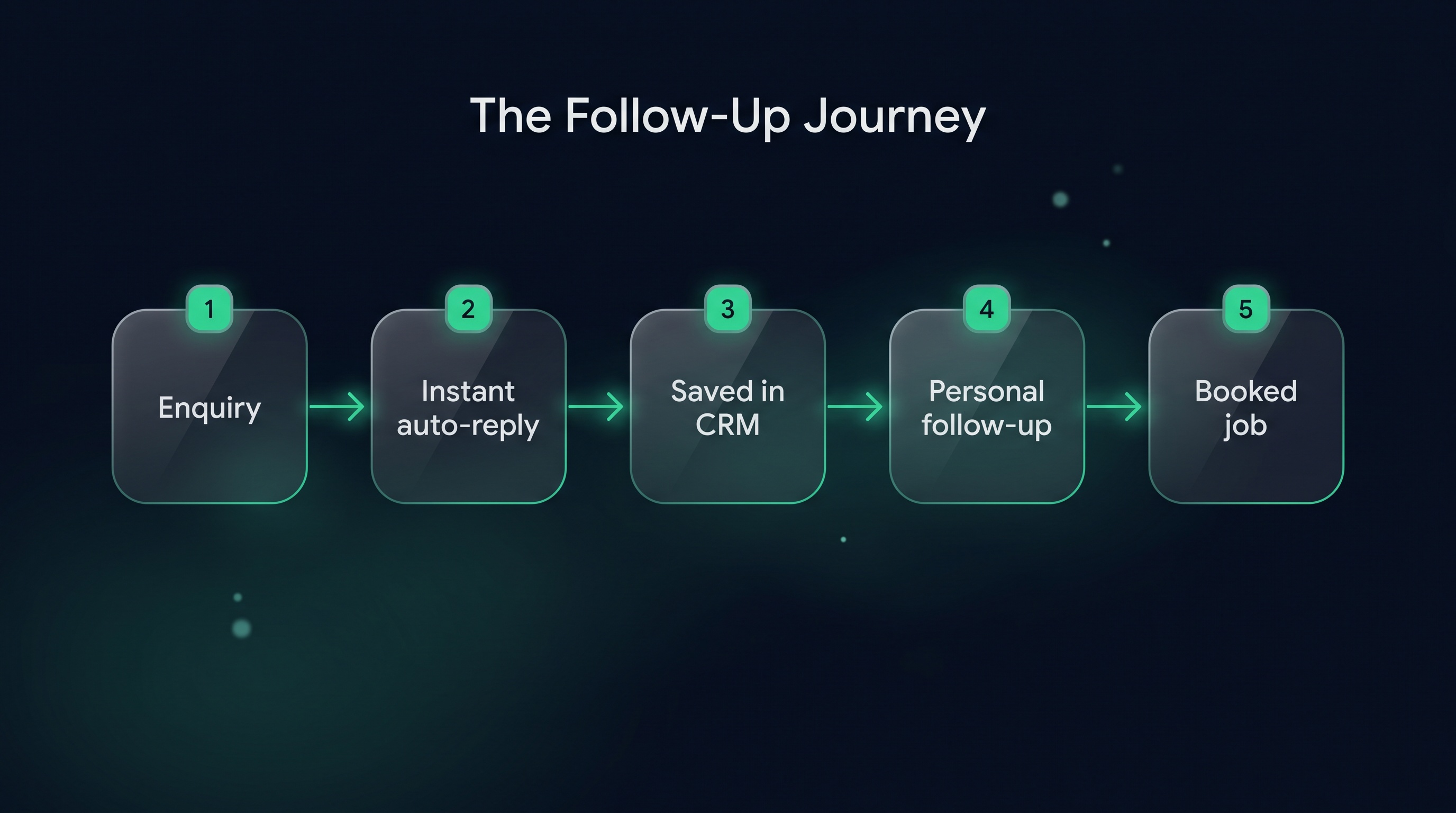
Here's the full path, start to finish:
- Instant confirmation — automatic, within seconds.
- A record is created — the enquiry lands somewhere it can't get lost.
- Personal follow-up — a real call or text within a couple of hours.
- Nurture sequence — short automated emails for the ones who go quiet.
- Booked job — status moves forward, automated emails stop.
- Source tracking — you learn which marketing actually worked.
Look at your own business against that list. Most local businesses we work with are doing one or two of these steps well and skipping the rest — and the skipped steps are where the leads quietly disappear.
Key takeaways
- An enquiry is peak interest. The first reply usually wins the job, so speed beats polish — within 5 minutes you're far likelier to qualify the lead.
- The confirmation isn't the follow-up. It's an automatic placeholder that buys you time before a real person reaches out.
- Memory is the weakest link. Every enquiry needs a record, or follow-up depends on you remembering while you're busy.
- Most leads go quiet, not cold. A short nurture sequence keeps you in the picture until they're ready.
- Always build a stop condition. Automated emails must pause the moment a real conversation starts.
- Track the source. Free UTM tags tell you which marketing actually produces booked jobs.
Common questions
How fast should I respond to a new enquiry?
Instantly with an automated confirmation, then personally within a couple of hours. The research is consistent: replying within 5 minutes makes you around 21 times more likely to qualify a lead than waiting 30 minutes. An automatic reply buys you the time to call back properly.
Isn't an automatic email impersonal?
Only if it's written like a robot. A short, plain confirmation — "Got your message, we'll be in touch shortly" — reassures the customer and sets you apart, because most businesses send nothing at all. The personal touch comes in the next step.
What if someone enquires and then goes silent?
That's normal — most people who go quiet aren't gone, they're just not ready. A short series of automated follow-up emails keeps you top of mind without nagging. When they reply, the sequence stops and a real conversation begins.
Do I need expensive software for all this?
No. Most of the journey runs on a basic CRM with simple workflow rules and free UTM tags on your links. The value isn't in fancy tools — it's in making sure each step happens at all, and on time.
Related articles
Want to see how your follow-up stacks up against the businesses you compete with?
Get a free competitor snapshot — we show you where rivals show up online and where the gaps are.
Get your free snapshot→