
You've built the store, loaded the products, maybe run a few ads - and the orders trickle in while the traffic doesn't. The frustrating part is that "do SEO" is useless advice for a shop with hundreds of pages. This guide cuts it down to the handful of things that actually move the needle, and names the ones that don't.
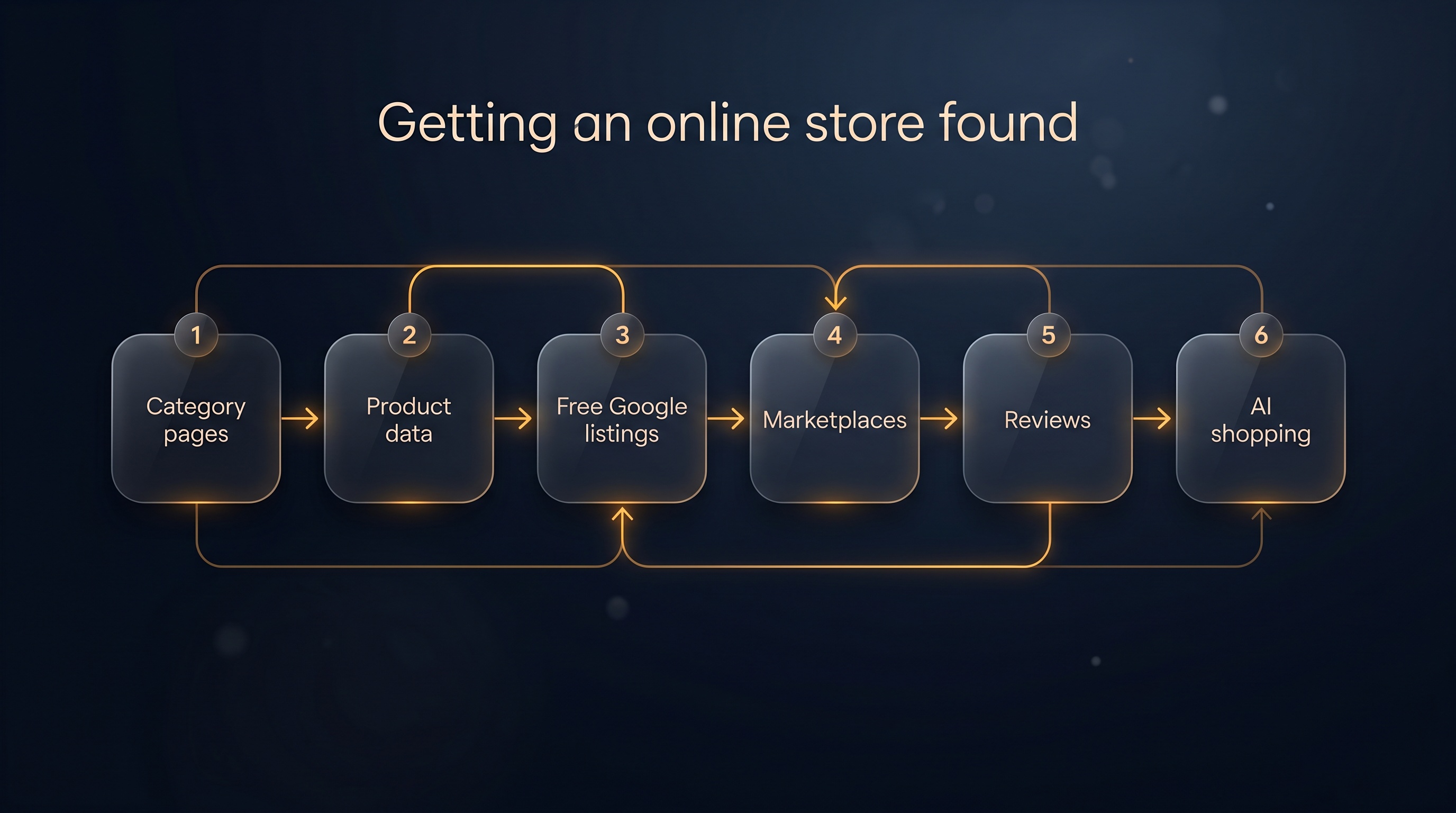
1Start with your category pages, not your products
Most store owners pour their effort into individual product pages. That's backwards for getting found.
Category and collection pages are the ones that rank for the searches with real volume - "[product type]" rather than one exact item. Analysis of commercial product keywords consistently finds category-style pages holding the top results for the majority of them. Product pages capture someone who already knows the exact thing they want; category pages capture everyone still deciding.
The fix is simple and almost nobody does it: give each important category page 150-300 words of genuine description - what's in the range, how to choose, who it suits - instead of dropping the visitor straight onto a wall of product tiles. A category page with real words to index consistently out-ranks a bare grid.
2Make every product page worth indexing
Two things decide whether a product page can rank, and both are within your control.
- Unique descriptions. Manufacturer copy pasted across your site (and fifty competitors') is thin, duplicated content - Google has nothing to tell you apart with. Write your own, even a few honest sentences per product, and you give it something to match against the long-tail searches people actually type.
- Complete product data (schema). Structured data - brand, price, availability, rating - is what makes your listing eligible for the rich snippets with star ratings and prices baked into the search result. One important caveat people get wrong: schema is not a ranking signal. Google says plainly it controls eligibility for rich results, not your position. It earns you clicks, not rank - and it only works if the data is complete. Partial markup gets you nothing.
3Turn on Google's free product listings
This is the most overlooked free channel in e-commerce. Through Google Merchant Center, your products can appear at no cost across the Shopping tab, Search, Images, Lens, YouTube and Gemini.
The catch is the feed. Any product missing a required field - id, title, image, price, availability, brand or GTIN - gets disapproved and disappears from every Google surface. Feed completeness is the first gate, before anything clever happens. Get the feed clean and complete first; it's free reach you're otherwise leaving on the table.
4Marketplaces: real reach, but on their terms
Amazon and Etsy put you in front of enormous, ready-to-buy audiences. Just don't treat them as "list it and forget it" - each runs its own search engine with its own rules.
- Amazon rewards products that pull in outside traffic that converts, have genuinely helpful reviews, stay reliably in stock, and follow its listing rules. It's a parallel SEO discipline, not a dumping ground.
- Etsy now leans on engagement - clicks, favourites, add-to-carts, strong photography - more than keyword-stuffed titles. Stuffing titles can work against you.
The trade-off to go in with eyes open: marketplaces buy you reach, but take a margin and bury your brand. They're a channel, not a replacement for your own store.
5Reviews: powerful, but know where
Reviews matter enormously - just be clear about what they do.
- For conversion, the evidence is strong: shoppers read them before buying, and products with a healthy stack of reviews convert far better than those with none.
- For clicks, star ratings shown in search results pull noticeably more traffic than a plain listing.
- For ranking, be honest - a direct Google ranking effect from reviews (and from replying to them) isn't established. Replying is a trust and conversion lever, not a proven SEO one. Don't let anyone tell you it "signals quality to Google."
So build reviews hard - for the sale and the click - not because someone promised they'll lift your rank.
6AI shopping is arriving fast - and you can't pay your way in
Shoppers are increasingly asking ChatGPT, Perplexity and Google's AI Overviews what to buy, and these surfaces recommend products organically - there's no ad slot to buy. What gets a product surfaced is the same boring fundamentals: complete, accurate product data, real pricing, genuine reviews, and in-stock availability. The mechanics are still settling and worth watching, but the preparation is clear - nail the fundamentals above and you're already surfacing-ready.
7When you do pay: Shopping first, long-tail always
For paid, Shopping / Performance Max is the workhorse - your product image, price and name show before the click, so the clicks you pay for already carry intent. Point your budget at specific long-tail terms ("boys size 12 navy polo", not "boys clothing"): fewer competitors bidding means cheaper clicks, and near-purchase intent means they convert. Keep broad head terms for awareness only - they're expensive and they leak budget.
Key takeaways
- Category pages win the high-volume searches - give them real words, not just a product grid.
- Unique product copy + complete data make product pages findable - but schema earns clicks, not rank.
- Google Merchant Center free listings are free reach - the feed just has to be complete.
- Marketplaces bring reach at the cost of margin and brand - treat them as their own SEO discipline.
- Reviews lift conversion and clicks strongly - the direct ranking claim is unproven.
- AI shopping is organic - you can't buy in; the fundamentals get you surfaced.
- Paid: Shopping/PMax plus long-tail terms; broad head terms for awareness only.
Common questions
I sell on Shopify - do I still need to do all this?
Shopify handles the plumbing - clean URLs, basic structured data, a Merchant Center sync. It won't write your unique descriptions, flesh out your category pages, or complete your product feed for you. The fundamentals are still yours to do.
Should I focus on my own store or sell on Amazon and Etsy?
It's rarely either/or. Marketplaces bring reach fast but take margin and bury your brand; your own store is the asset you control. Most stores run both deliberately - marketplaces for discovery, the store for the relationship.
Do I need product reviews to rank on Google?
A direct ranking effect isn't proven, so don't build them expecting one. Build them anyway - they lift conversion and click-through strongly, and they help feed the AI shopping surfaces.
Is SEO or paid ads faster for a new store?
Paid is faster: Shopping/PMax buys traffic today. SEO compounds over months. The usual play is to run paid for immediate sales while your category and product pages mature.
How much should I worry about AI shopping right now?
It's growing fast, but you can't pay your way in - the same complete-data fundamentals that win in Google Shopping are what get you surfaced in AI answers. Do the basics well and you've covered both at once.
Related articles
Want to see how your store's product visibility stacks up against your competitors - across Google, Shopping and the marketplaces?
Get a free competitor snapshot — we show you where rivals show up online and where the gaps are.
Get your free snapshot→