
You sent a quote, felt good about it, and then... nothing. No reply, no call, just silence. We see this in nearly every local business we work with — a pile of quotes sent and a quiet inbox. Here's the short answer: most of those quiet quotes aren't dead, and a short, friendly follow-up sequence wins a good share of them back. Below is exactly what to send and when.
1Why Silence Doesn't Mean No
A quiet quote feels like rejection. Usually it isn't.
The person who asked for your quote got busy. They're comparing two other quotes. They're waiting on a partner, a pay cheque, or a landlord. Your email slid down their inbox.
At the proposal stage, the average win rate is about 47% — so roughly half of sent quotes don't close. — RAIN Group Center for Sales Research, study of 472 sellers. At Bare Bayside Labs, we see businesses treat a sent quote like a finished job. It isn't. It's the halfway point, and the follow-up is where a lot of that other half gets decided.
So silence is normal. The mistake is reading it as a no and walking away.
2Why Most People Give Up Too Early
Here's the gap. The quote goes out, the business waits a day or two, hears nothing, and quietly writes it off.
A commonly cited sales figure suggests around 80% of sales need five follow-ups, yet 44% of reps give up after just one. — The Brevet Group. The number is an aggregate, not hard science, but the pattern matches what we see every week: the business that follows up calmly, more than once, is usually the one that gets the job.
You don't need to be pushy. You need to be present. There's a big difference, and the scripts below stay firmly on the friendly side.
3How Fast Should You Follow Up?
Speed matters more than most people think — especially the first response after the enquiry.
Contacting a lead within five minutes makes you about 21 times more likely to qualify it than waiting 30 minutes. — Oldroyd, MIT/Kellogg & InsideSales Lead Response Management Study. At Bare Bayside Labs, we tell every client the same thing: the speed you answer the first enquiry sets the tone for the whole conversation. By the time you're chasing a quiet quote, you're playing catch-up — so don't lose that early edge in the first place.
For the quote itself, the rhythm is gentler. You're not firing off a message every hour. You're spacing three touches over about two weeks.
4The 3-Message Recovery Sequence
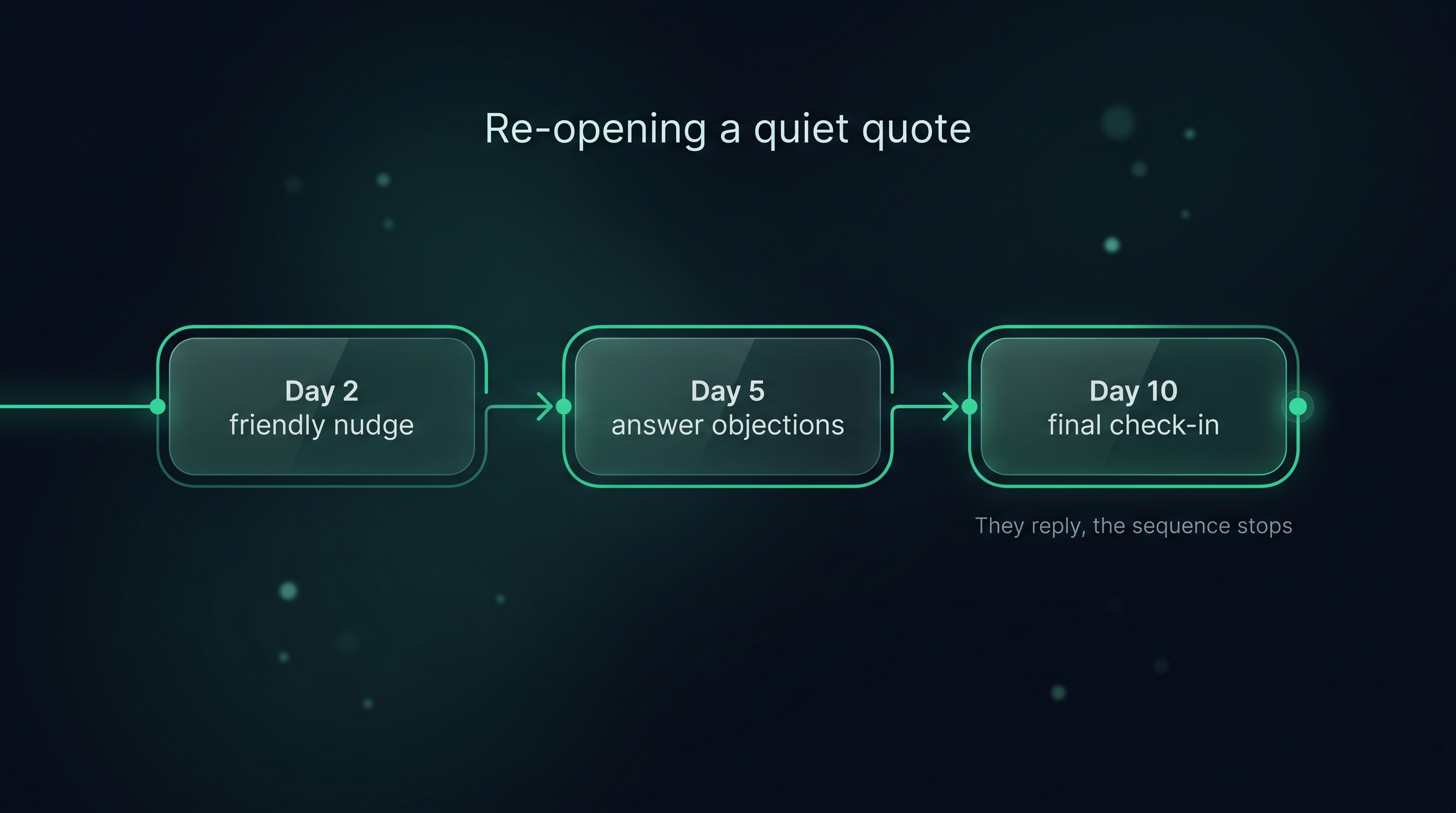
This is the simple sequence we recommend. Three messages, spaced out, each with a different job. Send by email, text, or whichever channel they used to reach you.
Message 1 — The Gentle Nudge (Day 2–3)
Two or three days after the quote, send a short, no-pressure check-in. The only goal is to float back to the top of their inbox.
Keep it under four sentences. Don't re-pitch. Don't apologise for "bothering" them.
Hi [Name], just making sure my quote for [the job] landed in your inbox — sometimes they slip into spam. No rush at all. Happy to answer any questions whenever you're ready.
That's it. You're being helpful, not chasing. Roughly half the replies you ever get will come from this one message.
Message 2 — The Value or Objection Nudge (Day 5–7)
If the first message gets no reply, the second one does a bit more work. Here you gently surface the thing that's probably holding them back — price, timing, or trust — and make it easy to say it out loud.
Pick the objection you hear most and address it without being defensive.
Hi [Name], still happy to help whenever the timing's right. A couple of things people often ask me at this stage: whether the quote can be staged into phases, and how soon we could start. If either's on your mind, just say the word and I'll talk you through it.
Notice what this does. It gives them an easy reason to reply, names a real concern, and signals flexibility — without dropping your price unprompted.
If you've got a relevant review or a quick photo of similar work, this is the message to attach it to. Proof reassures the person who's quietly comparing you to someone else.
Message 3 — The Polite Close (Day 12–14)
If two messages get no reply, send one final, graceful note. This is the "should I close your file?" message — and it works precisely because it lets them off the hook.
Hi [Name], I don't want to keep cluttering your inbox, so this'll be my last note on this one. If the timing's not right, no worries at all — I'll close the file for now and you can reach out anytime down the track. Either way, all the best with the project.
This message gets more replies than people expect. Some come back with "Actually, can we go ahead?" Others tell you they chose someone else — which is still useful, because now you know.
Then you stop. No one likes being chased after a clear ending.
5What Goes Wrong (And How to Avoid It)
A few small mistakes turn a good sequence into an annoying one.
Sending too many, too fast. Three messages over two weeks is plenty. Five emails in five days reads as desperate and gets you blocked.
Re-pitching the whole quote. They already have the quote. Pointing back to it once is fine; resending the full thing reads as pushy.
No stop point. Always end the sequence. The Day-14 close is the stop. After that, move them to a slow, occasional check-in — not the active chase.
Doing it from memory. This is where most quotes leak. If you're tracking quotes in your head or a messy inbox, you'll forget half of them. A simple CRM tags each quote with a date and reminds you to send each message, so the sequence actually happens. What a CRM actually costs breaks down whether that's worth it for a business your size.
6Make It Run Without You
Once you've written these three messages once, you never have to write them again. You can set them up so they send automatically when a quote stays unanswered, and stop the moment the person replies.
That's the same engine behind any good follow-up system — pre-written messages, sensible timing, and a stop condition. The 5 follow-up emails every local business should automate gives you the copy for the wider enquiry sequence, and the automated follow-up system shows how the whole thing fits together.
The point isn't to add more admin. It's to make sure the quote you worked hard on actually gets a fair second chance.
Key takeaways
- A quiet quote is not a no. Only about half of sent quotes close, so the silent ones are exactly where follow-up earns its keep.
- Three messages, spaced over two weeks. A gentle nudge at Day 2–3, a value or objection nudge at Day 5–7, a polite "close your file" note at Day 12–14.
- Be present, not pushy. Short messages, no re-pitching, and a clear ending keep you on the right side of annoying.
- The final "should I close your file?" message works. It lets people off the hook, which is exactly why so many of them reply.
- Always build in a stop point. When they reply or the sequence ends, the chasing stops — automatically if you've set it up in a CRM.
Common questions
How long should I wait before following up on a quote?
Two to three days for the first nudge. That's long enough not to seem impatient and short enough that the quote is still fresh in their mind. After that, space the next two messages out across the following week or two.
How many times should I follow up before giving up?
Three messages over about two weeks is a sensible default for most local businesses. The pattern across sales research is that persistence past one attempt pays off, but there's a point where more contact just annoys people. Three touches with a clear final message hits the balance.
What do I say in the last follow-up?
Make it the "should I close your file?" message. Tell them it's your last note, that there's no pressure, and that they can reach out anytime. Letting people off the hook often prompts the reply that two pushier messages couldn't.
Should I drop my price to win a quiet quote?
Not by default. Discounting before anyone has objected trains people to expect it and shrinks your margin. Surface the concern first — "happy to stage this into phases" or "we could start sooner" — and only talk price if price is genuinely the blocker.
Can I automate quote follow-ups?
Yes. A CRM can tag each quote with a sent date and fire each message on schedule, then stop the moment the person replies. That way the sequence runs even when you're on a job, and you're not relying on memory.
Related articles
Want to see why some quotes go quiet — like a competitor undercutting you or out-reviewing you nearby?
Get a free competitor snapshot — we show you where rivals show up online and where the gaps are.
Get your free snapshot→