
You know referrals are your best source of work, but actually asking for them makes you cringe. So you don't — and a steady stream of easy, high-trust customers just never shows up. We see this in almost every local business we look at: great work, happy customers, and no system for turning that into more work. The good news is you don't have to beg or feel salesy. A few small habits, built into how you already finish a job, do the asking for you. Here's the system.
1Why referrals are worth getting over the awkwardness
Before the how, it helps to see why this is worth a little discomfort. Referrals aren't just cheaper leads — they're better ones.
People trust a recommendation from someone they know more than any advertising you could buy. 88% of people trust recommendations from people they know — more than any other channel — Nielsen Trust in Advertising, 2021. A neighbour saying "call this guy" beats the slickest ad you'll ever run.
Referred customers are also worth more over time. A landmark Wharton study found referred customers had 16–25% higher lifetime value than customers who came from other sources — Schmitt, Skiera & Van den Bulte, 2011. At Bare Bayside Labs, we see referred customers show up pre-sold: they trust you before you've said a word, so they're easier to win and easier to keep.
So the prize is real. The problem isn't whether referrals are worth it — it's that "asking" feels like begging. The system below fixes that.
2Why asking feels pushy (and how to fix the feeling)
Asking for a referral feels gross when it's an interruption — a random "hey, know anyone who needs me?" that drops out of nowhere and serves only you.
It stops feeling pushy when three things are true:
- You've earned it. You did genuinely good work, so a recommendation is something the customer would be glad to give.
- It's the natural moment. You ask when they're happiest, not weeks later out of the blue.
- It's easy and low-pressure. You make it simple, you don't demand anything, and you're fine if they don't.
Get those right and you're not begging. You're giving a happy customer an easy way to do something they'd be willing to do anyway. The five steps below build all three in.
3Step 1: Do work worth talking about
This is the foundation, and most "referral hacks" skip it. No system rescues mediocre work. People only refer when they're confident their own name is safe in your hands.
So the first step is uncomfortable but simple: be genuinely good, and finish the job in a way people remember. That means a clean handover, doing what you said you'd do, and one small thing they didn't expect.
The small extra matters more than you'd think. The thing people tell their friends about is rarely the core job — it's the moment you went slightly beyond it. The tidy-up, the quick fix you didn't charge for, the follow-up call to check it's still good.
If referrals are thin, start here before blaming the asking. Sometimes the work is fine but forgettable, and "fine" doesn't get talked about.
4Step 2: Make referring you effortless
Even happy customers won't refer you if it's any work. They have to remember your name, find your number, and explain what you do — and most won't bother, not because they don't like you, but because life's busy.
Your job is to remove every bit of that friction.
- Have something easy to pass on. A saved contact card, a one-line text they can forward, a simple link to your site or quote form. Something a customer can send in five seconds.
- Make your name memorable and findable. If a customer wants to recommend you next week, can they find you again? A clear business name, an easy-to-remember way to reach you, and an up-to-date Google profile all help.
- Give them the words. People freeze when they don't know what to say. A simple line like "they did our [job] and were great — here's their number" is all they need. You can hand them that line.
The easier you make it, the more it happens — without you having to ask harder.
5Step 3: Ask at the right moment (and the right way)
This is where most people go wrong, and it's the part that feels pushiest when done badly.
The right moment is the peak of happiness — right when the work is done and the customer is visibly pleased. The job's finished, it looks great, and they're relieved and grateful. That's when a gentle ask feels natural, not when you cold-message them three weeks later.
The right way is soft and pressure-free. You're not demanding anything. Try something like:
"Really glad you're happy with how it turned out. If you ever come across someone who needs the same kind of work, I'd really appreciate you passing my details on. No pressure at all — I just get most of my work through word of mouth."
That last line does a lot. It tells them honestly why it matters to you, which makes helping feel meaningful rather than like a favour to a pushy salesperson.
A quiet, no-ask version
If even that feels like too much, there's a softer route: don't ask out loud at all. Just make it easy and mention it lightly.
When you hand over the finished job, leave a couple of contact cards and say, "Pop one of these on the fridge in case a neighbour ever asks." No request, no pressure — you've simply put the tool in their hand. Many people then refer without ever being directly asked.
6Step 4: Thank every referral, every time
When someone does send you work, close the loop. A genuine thank-you is what turns a one-off referral into a repeat referrer.
It doesn't need to be a reward — a sincere message goes a long way. "Just wanted to say thanks — [name] mentioned you sent them my way. Really appreciate you thinking of me." That's it. People who feel appreciated do it again.
A word of caution on rewards: paying for referrals can change the feel of the whole thing, and on some platforms (like incentivising reviews) it breaks the rules. Keep it simple. A heartfelt thanks, and maybe a small unexpected gesture for someone who refers you often, is plenty. The relationship is the reward.
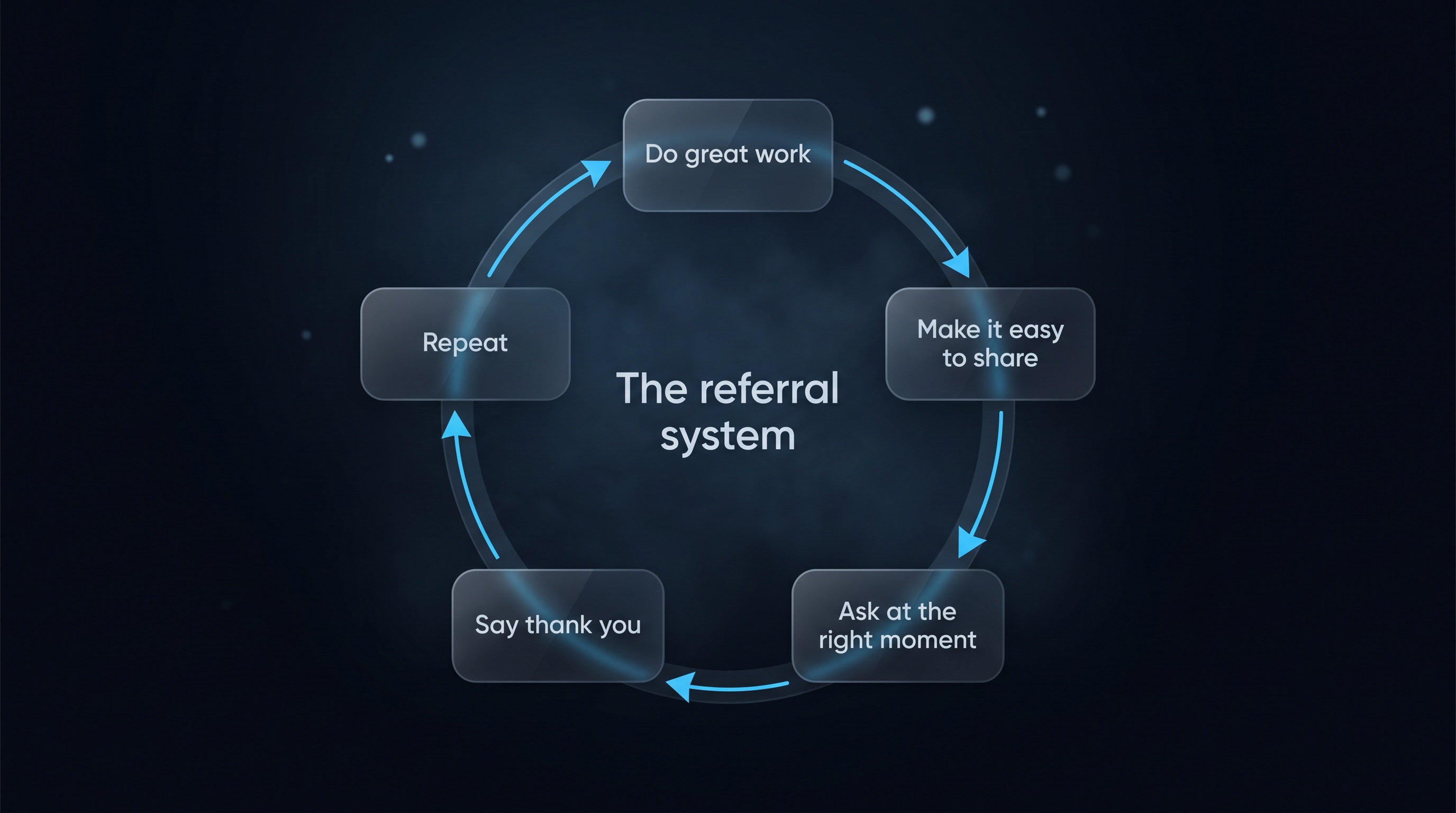
7Step 5: Make it a habit, not a one-off
The reason referrals stay a trickle is that asking is a thing you do when you remember — which is almost never. The fix is to bolt it onto something you already do every single time.
Pick a trigger that's already part of finishing a job:
- When you send the final invoice, that's your cue to leave the cards or send the soft ask.
- When you do your end-of-job tidy-up, that's when you say the line.
- When a customer texts "looks great, thanks!", that's your prompt to reply with a gentle "so glad — feel free to pass my details on if anyone asks."
Tie it to an existing step and it becomes automatic. You stop relying on willpower, and a slow trickle turns into a steady stream.
This is the same logic behind the after-job review request system — build the ask into the moment the job ends, so it happens every time without you thinking about it. Reviews and referrals are close cousins: both are happy customers vouching for you, and the same well-timed habit captures both. If you want the review side handled too, our guide to getting more Google reviews covers the exact timing and scripts.
Referrals are one piece of a bigger picture. For how they fit alongside getting found, getting chosen, and following up, see the local business marketing playbook.
Key takeaways
- Referrals are your highest-trust, highest-value leads — 88% of people trust a recommendation from someone they know, and referred customers carry 16–25% higher lifetime value.
- Asking feels pushy only when it's badly timed and self-serving. Earn it, ask at the peak moment, and keep it easy, and it stops feeling like begging.
- Do work worth talking about first. No referral system rescues forgettable work — one small unexpected extra is what people actually mention.
- Remove every bit of friction. Give customers something easy to pass on and the words to say, so referring you takes five seconds.
- You don't even have to ask out loud. Leaving cards with a light "in case a neighbour asks" often works better than a direct request.
- Make it a habit tied to an existing step — the final invoice, the tidy-up, the thank-you text — so it happens every time on its own.
Common questions
Isn't it unprofessional to ask customers for referrals?
Not if you've done good work and you ask gently at the right moment. You're giving a happy customer an easy way to help, not demanding a favour. The version that feels unprofessional is the random, pushy ask weeks later — which the system above avoids.
Should I pay people for referrals?
You don't need to, and it can change the feel of the relationship. A genuine thank-you keeps referrals feeling like goodwill rather than a transaction. Be careful with incentives — on some platforms, like Google reviews, paying for them breaks the rules.
When exactly is the best time to ask?
Right when the job's finished and the customer is visibly happy — that's the peak of goodwill. Asking on the spot, while you're still there, beats following up days or weeks later when the moment has passed.
What if I ask and they say no, or just don't do it?
That's completely fine, and it's why the soft, no-pressure wording matters. Most people who don't refer simply forgot or got busy, not that they were unhappy. Leaving them something easy to pass on later (a card, a link) means the door stays open.
How do referrals fit with online reviews?
They're two sides of the same coin — both are happy customers vouching for you. The same well-timed, low-friction habit that earns referrals also earns reviews, so it's worth building one routine that captures both.
Related articles
Want to see where your competitors are winning word-of-mouth and where you can gain ground?
Get a free competitor snapshot — we show you where rivals show up online and where the gaps are.
Get your free snapshot→