
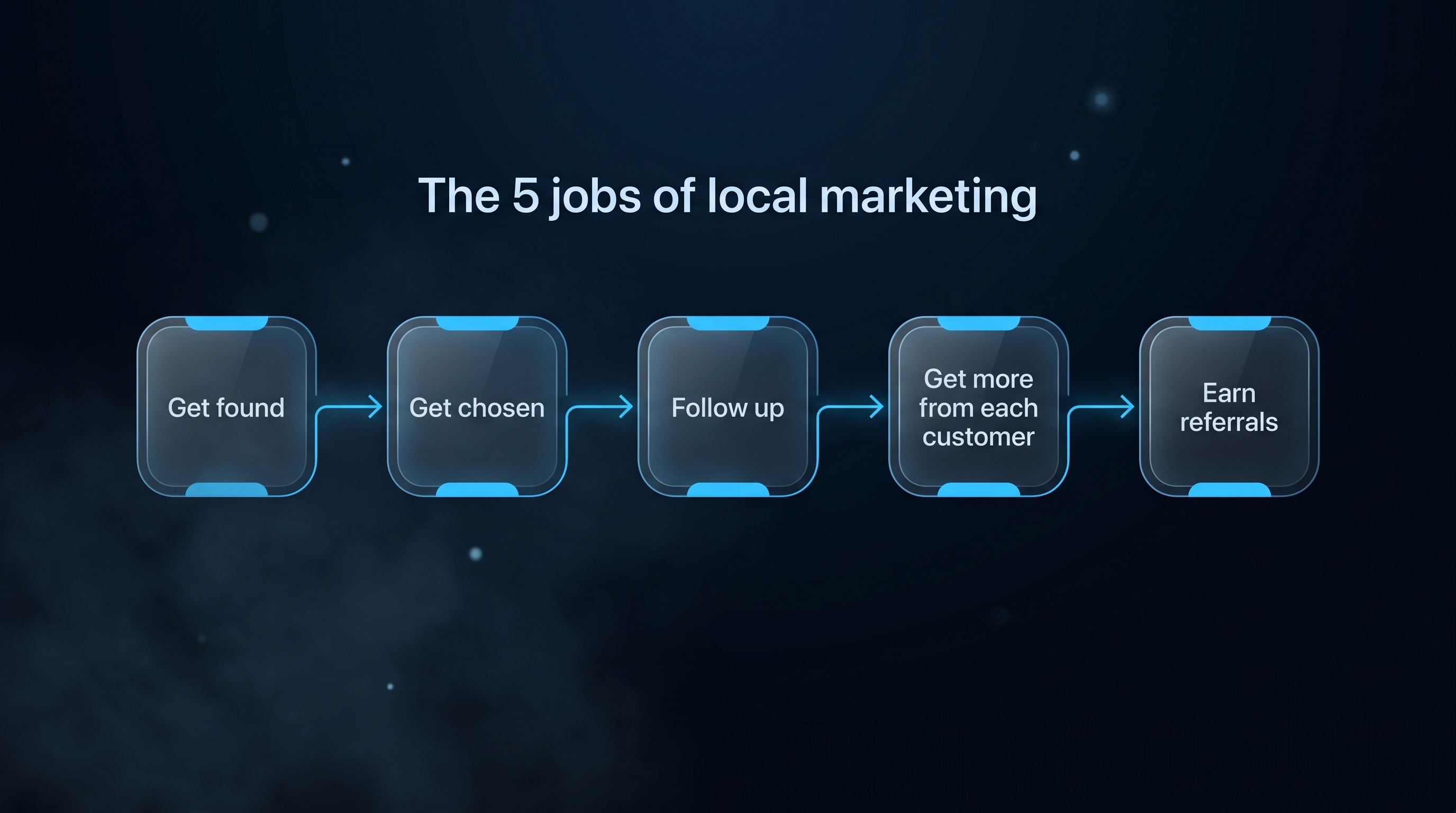
You're good at the work. The problem is getting enough of the right people to call you in the first place. We see this in nearly every local business we look at — the trade is solid, but the marketing is a patchwork of half-finished bits that nobody's sure are working. The short answer: local marketing comes down to five jobs done in order — get found, get chosen, follow up, get more from the people you've already won, and earn referrals. This playbook walks through each one and points you to the deeper guide for every piece.
1The whole job in one picture
Most local marketing advice throws tactics at you with no order. That's why it feels overwhelming.
Here's the simpler way to think about it. A customer travels through five stages to get to you, and your marketing has one job at each:
- Foundations — be a real, trusted business someone can find and believe.
- Getting found — show up when people search, on Google and now in AI tools.
- Getting chosen — once they find you, give them a reason to pick you over the next listing.
- Following up — chase the enquiries you get so they don't go cold.
- Referrals — turn happy customers into the people who bring you the next ones.
Skip a stage and the others leak. Brilliant follow-up can't save you if nobody finds you. Top rankings are wasted if your profile gives people no reason to call. Work through them in order.
2The foundations checklist: four things to fix before anything clever
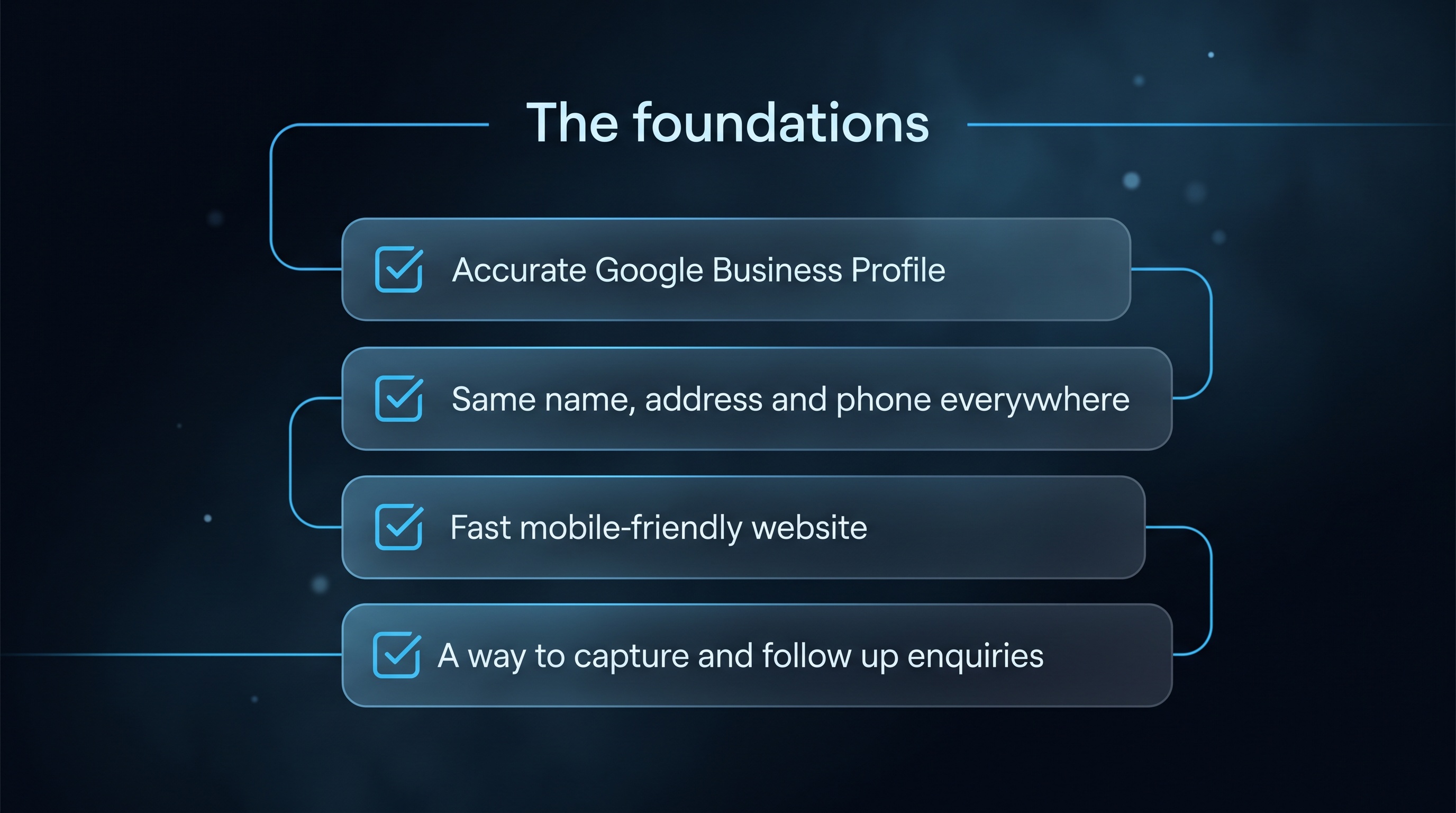
Before any tactic, four things have to be true. If any one of them is missing, the money you spend on the rest leaks straight back out. Run down this list first.
1. An accurate, complete Google Business Profile. It's free, and it's the single most important local listing you have. Your name, what you do, your hours, your service area, and photos — all filled in, all correct. This is the profile that shows in the map when someone searches for your service nearby.
2. The same name, phone, and address everywhere. Your business name, phone number, and address should read identically on your website, your Google profile, and every directory. Mismatches confuse both customers and search engines, and they're easy to miss because you wrote them at different times. The deeper version of this — speed plus consistent details — is in a fast site with consistent details.
3. A website that loads fast and works on a phone. Most people who find you will be on their phone. A slow or fiddly site loses them before they ever see your work, no matter how good it is.
4. A way to capture and follow up on enquiries. A tappable phone number, a short form, and somewhere those enquiries land so none get lost. This is the one most businesses skip, and it's the most expensive gap of the four.
If you can tick all four, you have a foundation. If you can't, start there — none of the later work pays off without it.
Why reviews sit at the centre of everything
Reviews do double duty, which is why they're worth a habit rather than an afterthought.
For getting chosen, the numbers are stark. 97% of consumers read online reviews for local businesses, and 68% will only use a business rated 4 stars or higher — BrightLocal Local Consumer Review Survey, 2026. At Bare Bayside Labs, we see the business with fresh, plentiful reviews win the call even when a quieter competitor does better work.
Customers also care about freshness. 74% want reviews from the last three months — BrightLocal, 2026. A wall of five-star reviews from two years ago reads as "they used to be good."
The full system for asking — when to ask, the exact script, how to make it a habit instead of a chore — lives in our guide to getting more Google reviews.
3Getting found: how customers actually look for you in 2026
Once your foundations are solid, the next job is showing up when someone goes looking. In 2026 that means two places: traditional search and AI tools. Both matter, and the good news is the work mostly overlaps.
How people search has always leaned local
A large share of what people type into Google is looking for something nearby. A long-established and widely cited Google figure puts it at roughly 46% of searches having local intent — note that's an older, established number, not a fresh 2026 measurement. The behaviour it describes hasn't gone anywhere: people search for a service, then choose from what's close.
That urgency is the reason speed matters. Another established Google figure found 76% of people who search for something nearby on a phone visit a business within a day — again, an older Google statistic, but it captures something still true. When someone searches "plumber near me," they're not browsing. They're ready.
4The channels for getting found, one at a time
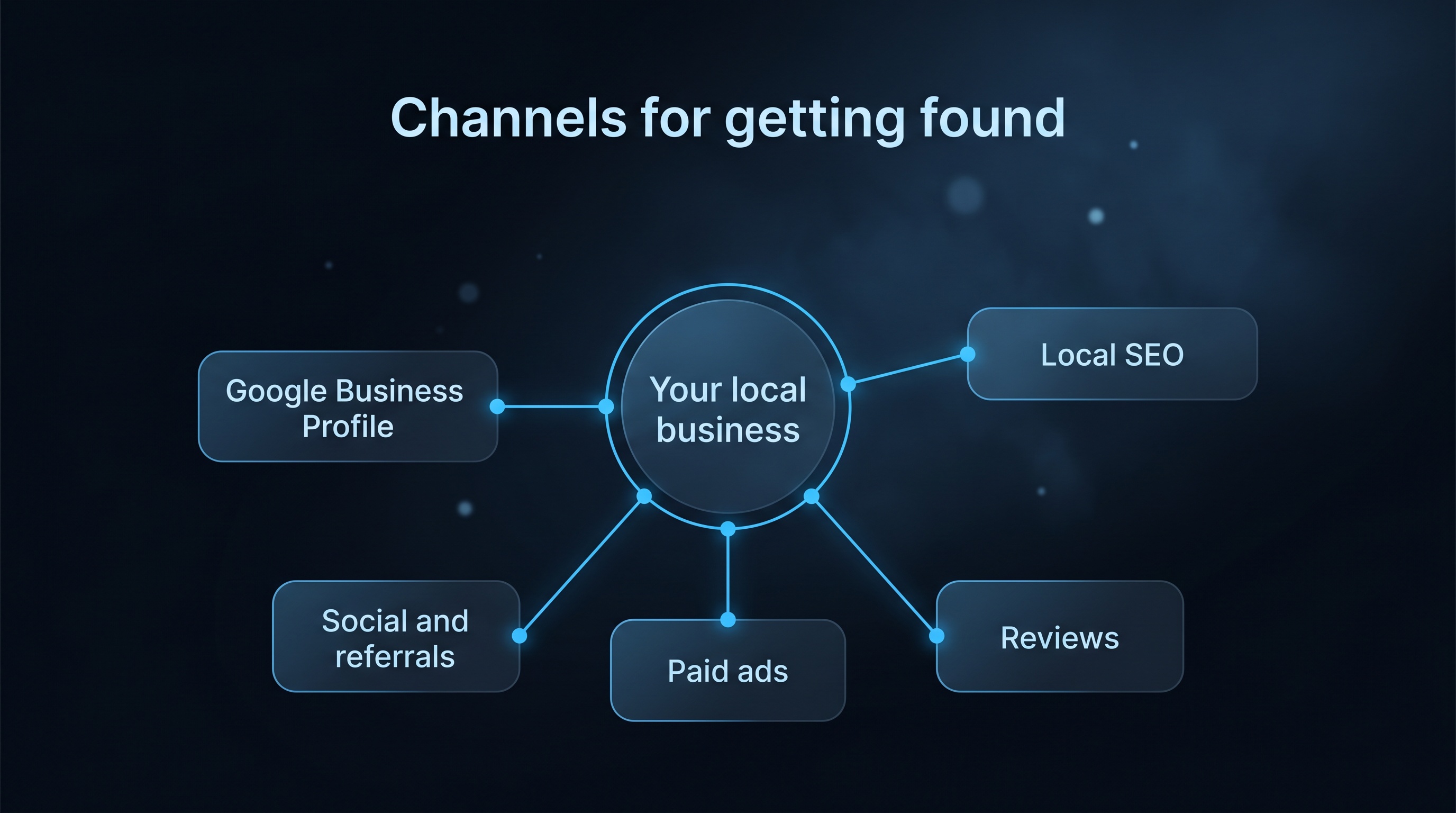
Not every channel deserves your time. Here's a crisp pass on each — what it's for, and when it's worth the effort.
Google Business Profile and the map. This is the front door for local search. When someone searches your service nearby, the map results sit above everything else, and your profile is what fills them. It's free, it's the highest-leverage thing you own, and it's worth the effort for every single local business. Complete it first; keep it accurate.
Organic search and your website (SEO). This is showing up in the regular blue-link results below the map — for your service, your area, and the questions customers ask. It's slower than the map and it compounds: the pages you write keep earning for months. Worth it for almost everyone, especially if you serve more than one area. The full picture lives in our SEO for small business in 2026 guide.
Reviews. Reviews aren't a separate channel so much as fuel for the others — they help you rank in the map and they convince people to choose you. Worth a steady habit from day one, not a one-off push.
Paid ads. Ads buy you the top of the page today instead of waiting for rankings to build. They're worth it when you need leads now, when you're new and invisible, or when a competitor owns the organic results. The catch is they stop the moment you stop paying — so treat them as a tap, not a foundation. If your ads aren't working, the usual reasons are in why your ads aren't working, and the first-campaign basics are in your first Google search campaign.
Social and referrals. Social keeps you visible to people who already know you and gives proof to people checking you out — it rarely wins cold customers on its own. Referrals are the highest-trust source of all, covered in its own stage below. Both are worth it, but as amplifiers, not as your only plan. The honest take on which channels actually matter is in the only three marketing channels a local business needs.
Getting found on Google
Google decides who shows up in local results using three things: relevance, distance, and prominence.
The catch most business owners miss is how little of that you control. Distance — how close you are to the person searching — is dominant in the map results and you can't change it. What you can shape is relevance (telling Google clearly what you do) and prominence (reviews, mentions, a solid website).
This distinction decides where your effort actually pays off, so it's worth understanding properly. The full breakdown of what you control and what you don't is in how Google ranks local businesses.
Getting found in AI search
This is the new one, and it's moving fast. People increasingly ask ChatGPT, Google's AI Overviews, or Perplexity for a recommendation instead of scrolling a results page.
It's not a fringe habit anymore. 45% of US consumers used AI tools to find local business recommendations in 2026, up from 6% the year before — now the third most-used tool behind Google and Facebook — BrightLocal, 2026. At Bare Bayside Labs, we already see AI tools shaping which businesses get the first call, especially among younger customers.
The reassuring part: getting cited by AI is mostly the same work as good SEO. Clear pages, plain answers to real questions, and being mentioned across the web. Our SEO for small business guide folds the AI-search piece in, so you don't have to treat it as a separate project.
5Getting chosen: give them a reason to pick you
Showing up is half the battle. The other half is what happens in the ten seconds after someone lands on your listing or site. They're comparing you to the next option, and they decide fast.
Lead with proof, not promises. Anyone can say "quality work, fair prices." Reviews, photos of real jobs, and clear answers to common worries do the convincing. This is where those reviews earn their keep a second time.
Be clear about what you do and where. A vague listing loses to a specific one. If a customer can't tell in two seconds whether you handle their exact problem in their exact area, they move on.
Make the offer easy to understand. Confused people don't buy. Plain pricing guidance, a clear next step, and an easy way to get in touch beat a slick site that hides the basics. The case for showing prices is in why pricing transparency wins quotes.
Reduce the friction to contact you. A phone number people can tap, a short form, an obvious "get a quote" button. Every extra step costs you enquiries — more on the easy-booking signals in trust signals and easy booking.
The thinking behind which channels deserve your attention here — and which are a waste of time for a local business — is laid out in the only three marketing channels a local business needs. Most owners are spread across six when three would do better work.
6Following up: stop the leaks after the enquiry
Here's where the most money quietly leaks out of a local business. You did the hard part — someone found you and reached out — and then the follow-up falls apart.
It's not a character flaw. It's a systems gap. You're on a job, the enquiry sits in your inbox, and by the time you reply they've booked someone else.
The data on this is brutal. Across thousands of companies, the average first response to a web lead was 42 hours, only 37% responded within an hour, and 23% never responded at all — Harvard Business Review, "The Short Life of Online Sales Leads," 2011. At Bare Bayside Labs, slow or missing follow-up is the single most common leak we find.
And the leak isn't just at first contact. A commonly cited sales figure suggests around 80% of sales require five follow-ups, yet 44% of reps give up after one (the Brevet Group; treat as a rule of thumb, not hard data). Most businesses quit long before the customer was ready.
The fix is to stop relying on memory. A simple automated system — instant reply when someone enquires, a record so nothing gets lost, and a short follow-up sequence that runs on its own — closes the gap. We cover the whole thing in marketing automation for small business, the companion hub to this one, and the practical build is in how to stop losing leads. Start there if "I keep losing enquiries" is your biggest pain.
7Referrals: turn happy customers into your best marketing
The cheapest, highest-trust customers you'll ever get come from the customers you already have. And most local businesses leave this on the table entirely because asking feels awkward.
It shouldn't. 88% of people trust recommendations from people they know — more than any other form of advertising — Nielsen Trust in Advertising, 2021. No ad you can buy carries that weight.
Referred customers are also worth more. A landmark Wharton study found referred customers had 16–25% higher lifetime value than non-referred ones — Schmitt, Skiera & Van den Bulte, 2011. They stay longer and spend more.
The trick is having a simple, repeatable system so you ask consistently without ever feeling pushy. We built one that doesn't involve begging — it's in how to get more referrals without feeling pushy.
8What the five jobs look like in practice
The sequence is easier to trust once you see it run. Here are two quick examples using generic trades — qualitative, not a promise of numbers.
A mobile mechanic
Foundations first: he claims his Google profile, lists exactly which suburbs he covers and which jobs he does, and adds photos of real work. His phone number is tappable on every page. Getting found: because the profile is specific and his reviews stay fresh, he starts surfacing for "mobile mechanic near me" and in the occasional AI recommendation. Getting chosen: the photos and recent reviews do the convincing — a customer can see in seconds that he handles their exact problem. Following up: instead of letting a missed call go cold while he's under a car, an automatic text replies and logs the enquiry so he calls back that evening. Referrals: after a job done well, a simple, friendly ask turns one happy customer into the next two. No single step is clever. The order is what makes it work.
A cleaning company
Same five jobs, different shape. Foundations: consistent name and number everywhere, a fast mobile site, a short quote form. Getting found: they lean on organic search and reviews rather than paid ads, writing plain pages for the services and areas they cover. Getting chosen: transparent pricing guidance and easy booking remove the hesitation that makes people keep shopping. Following up: a quote that goes quiet gets a gentle nudge a couple of days later instead of being forgotten. Referrals: they make it the norm to ask satisfied clients, because a clean home is something people happily recommend. Where the mechanic leaned on the map and instant reply, the cleaner leaned on organic pages and quote follow-up — but the five jobs are identical.
9Where to put your energy first
You don't do all five at once. Here's the order that works for most local businesses:
- Fix the foundations — complete your Google profile, get your details consistent, start collecting reviews. A week of work.
- Plug the follow-up leak — if enquiries are slipping, this returns money fastest. Automate the instant reply and a basic sequence.
- Get found properly — work on relevance and reviews so you climb in Google and show up in AI tools.
- Sharpen getting chosen — make your listing and site give people a clear reason to pick you.
- Build the referral habit — once you're delivering well, turn that into a steady stream of new work.
If you only do one thing this week
When you can't do all of it, the right single move depends on where the leak is. Use this:
- Getting enquiries but losing them? Fix follow-up. Set up an instant auto-reply so nothing dies in your inbox while you work. This returns money fastest because you're capturing demand you already have.
- Not getting found at all? Complete your Google Business Profile. It's free, it's an afternoon's work, and it's the front door for local search.
- Found, but people pick someone else? Sort your reviews and your listing. Fresh reviews plus a clear, specific profile is what tips the ten-second decision your way.
- Steady work but want more, cheaper? Build the referral habit. You already have the customers; you're just not asking.
When you're genuinely unsure, the honest answer is usually "follow-up first, found second." Start where the money's walking out the door.
Key takeaways
- Local marketing is five jobs in order: foundations, getting found, getting chosen, following up, and referrals. Skip one and the others leak.
- Get the four foundations right first — accurate Google profile, consistent details, a fast mobile site, and a way to capture enquiries. Nothing else pays off without them.
- Reviews do double duty — they help you get found AND get chosen, with 97% of people reading them and 68% only using 4-star-plus businesses.
- You control relevance and prominence, not distance. Spend your effort where it actually moves the needle, not on the part Google won't let you change.
- AI search is now mainstream — 45% of US consumers used AI tools for local recommendations in 2026, and the work to show up there overlaps with good SEO.
- Follow-up is the biggest leak. Most businesses respond slowly or not at all, and give up after one try. A simple automated system fixes it.
- Referrals are your cheapest, most trusted source — 88% trust a recommendation from someone they know, and referred customers are worth more over time.
Common questions
What's the one thing I should fix first?
Usually your follow-up. If enquiries are coming in but not converting, that's money already walking out the door, and it's the fastest fix. If you're not getting found at all yet, start with completing your Google Business Profile instead.
Do I need to be everywhere — every social platform, every directory?
No. Most local businesses do better focusing on a few channels well rather than spreading thin across many. A complete Google profile, a fast website, steady reviews, and good follow-up beat being half-present on six platforms.
Are paid ads worth it for a local business?
They can be, but as a tap you turn on, not a foundation. Ads buy you the top of the page today — useful when you're new, invisible, or need leads now — but they stop the moment you stop paying. Fix your profile, reviews, and follow-up first so the clicks you pay for don't leak.
Is AI search actually worth worrying about as a small business?
Yes, but you don't need a separate strategy for it. AI tools are now the third most-used way people find local businesses, and the work to show up in them is largely the same clear, helpful content that good SEO needs anyway.
How long before local marketing pays off?
Follow-up improvements can show results in days because you're capturing enquiries you were already getting. Getting-found work (rankings, reviews, AI visibility) builds over weeks and months — it's slower but compounds.
I'm a one-person business with no time. Where do I even start?
Pick the single biggest leak. Complete your Google profile (an afternoon), then automate your instant reply to enquiries so nothing gets missed while you're on a job. Those two cover the most common gaps with the least ongoing effort.
Related articles
Want to see how your business looks to a local customer comparing you against your competitors?
Get a free competitor snapshot — we show you where rivals show up online and where the gaps are.
Get your free snapshot→