
You run a local business and you want one thing: when someone nearby searches for what you do, you show up. The problem is the rules changed. People now find businesses through Google's map, Google's normal results, and — increasingly — by asking an AI like ChatGPT. The short answer is that SEO for small business in 2026 means doing the same solid fundamentals you always needed, then making sure your information is clear enough for an AI to repeat it back. This guide walks through the whole picture: how local search actually works, what you can and can't control, the on-page basics, reviews, and the AI-search piece that most businesses are still ignoring.
1How local search actually works
When you search for a local service, Google shows two things stacked together. Up top is the map box — a small map with usually three businesses pinned under it. Below that are the normal blue-link website results. They're ranked by different rules, and that trips a lot of people up.
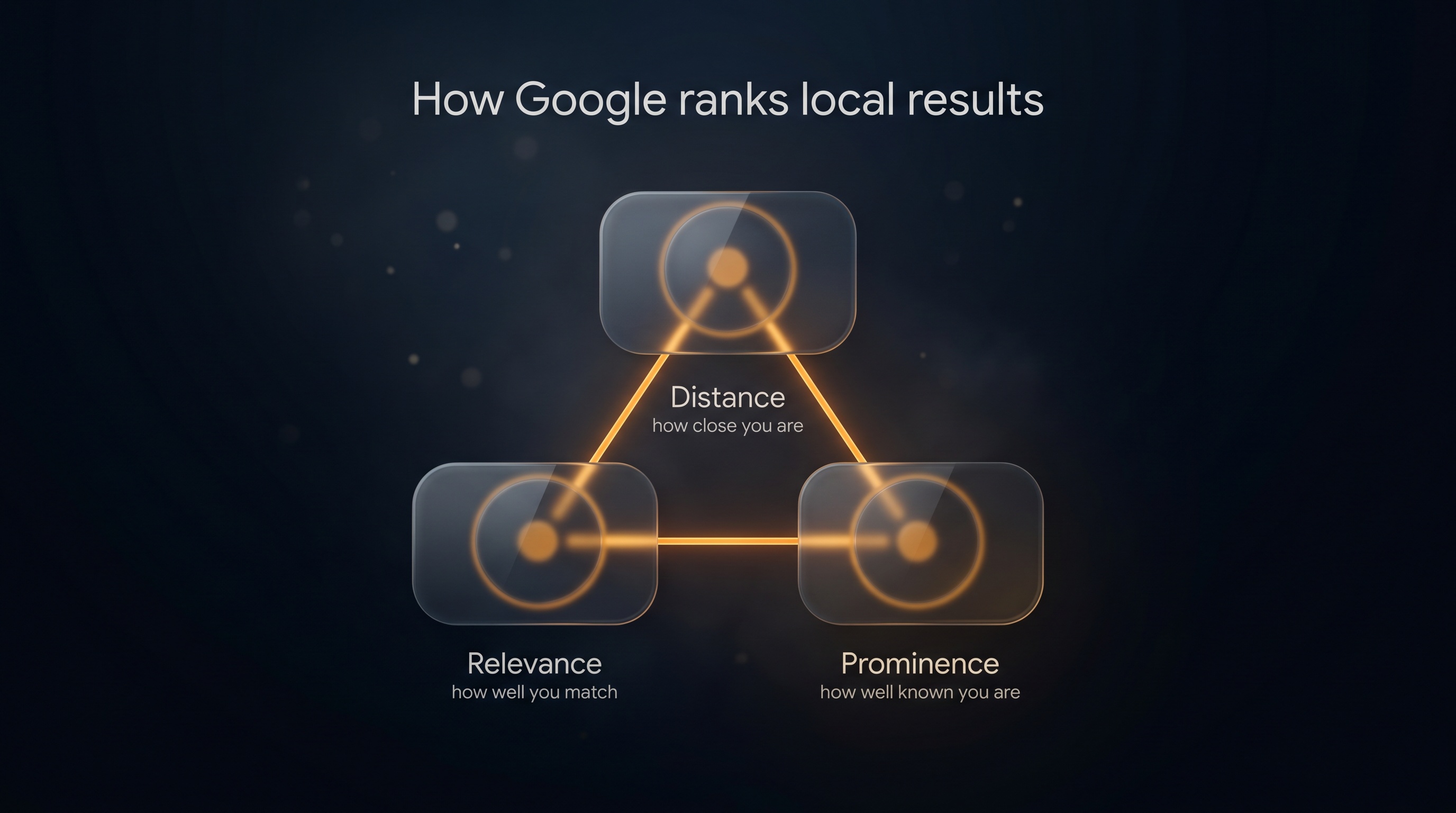
Google says local results are based on three things: relevance, distance, and prominence (Google Business Profile Help). Get those three straight and everything else makes more sense.
- Relevance is how well your business matches what the person searched. A plumber matches "emergency plumber," not "garden landscaping." This is the part you shape most directly.
- Distance is how far your verified business address is from the searcher. The closer you are, the better your odds in the map box.
- Prominence is how well-known and well-regarded your business is — reviews, mentions, links, an established web presence.
We dig into each one in How Google Ranks Local Businesses. For now, the headline is that two of these three are things you can move, and one mostly isn't.
2What you control — and what you don't
This is the most useful distinction in local SEO, and almost nobody explains it honestly.
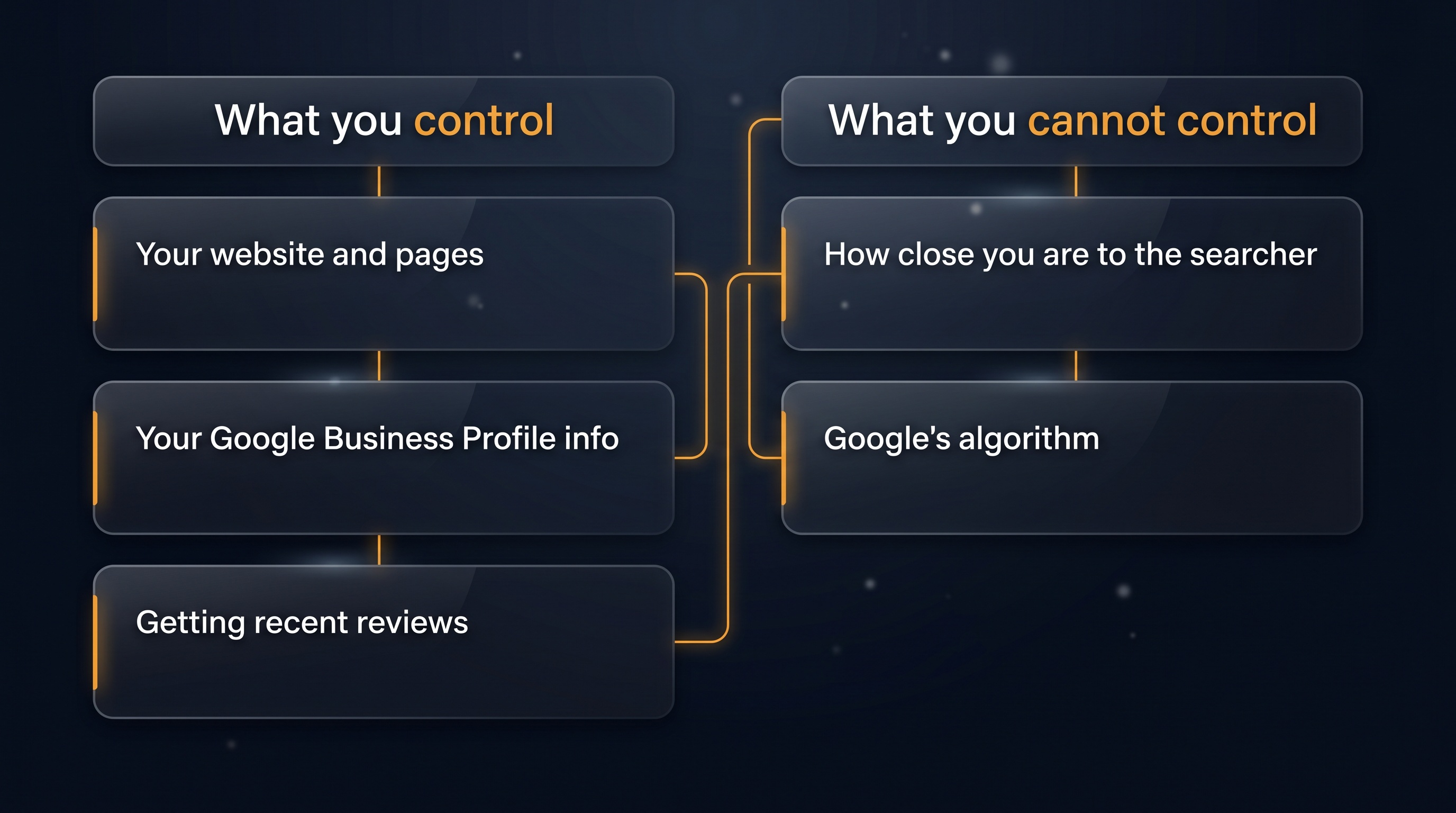
Distance is mostly out of your hands. Google measures it from your verified address to wherever the searcher is standing. You can't change where your customers are, and you can't fake your address. If a competitor sits closer to the person searching, they often win the map box for that search — full stop. Chasing proximity is chasing something you can't control.
There's a popular myth worth killing here. Many people believe that filling in the service-area field on your Google Business Profile — listing all the towns you cover — makes you rank in those towns. It doesn't. The service-area field tells customers where you'll travel; it isn't a ranking lever for the map box. Proximity still rules there.
So what can you move? Quite a lot, actually.
- Relevance — through your website content and the "Services" you list on your profile.
- Prominence — through reviews, genuine mentions of your business around the web, and a useful, well-built site.
The trick is to spend your energy on the controllable two and stop fighting the one you can't.
A quick way to picture it: distance decides which businesses are even in the running for a given searcher, and relevance plus prominence decide who wins among them. You can't make yourself closer to everyone — but you can be the most relevant, most trusted option in the pool you're already in. That's where the work pays off.
It's also why two businesses on the same street can rank very differently. Same distance, same town — but the one with the clearer Services list, the better reviews, and the more useful website pulls ahead. None of that is luck, and none of it requires tricks. It's just the controllable levers being pulled instead of ignored.
3The Google Business Profile lever you're probably missing
Your Google Business Profile (the free listing that powers the map box) has a Services section — the actual list of jobs you do. This one is a real relevance lever, and most businesses leave it half-empty.
If you're an electrician and someone searches "switchboard upgrade," you've got a far better shot if "switchboard upgrade" is one of your listed services. Spell out what you do in the words your customers use. Don't list "electrical solutions" — list "switchboard upgrades," "EV charger installation," "ceiling fan installation," and so on.
This is the opposite of the service-area myth. The service-area (where) doesn't move rankings. The Services list (what you do) genuinely helps relevance. Keep them straight.
While you're in there, finish the rest of the profile too. The category you pick, the description, your hours, photos of real work, and a steady drip of posts all help Google understand who you are and who to show you to. An incomplete profile is the most common, most fixable problem we see — and it costs nothing but an afternoon to put right.
4On-page basics: your website still matters
The map box gets the attention, but the website results underneath it are real estate too — and your own site is the one asset you fully own. A few fundamentals carry most of the weight.
A fast site that loads cleanly on a phone. Most local searches happen on a phone. If your site is slow or fiddly on mobile, people leave, and that hurts you in both search and conversions.
Clear pages that say what you do and where. One page per main service, written in plain language, with your service area named. Don't make Google guess what you do — say it directly, in the words people actually search.
Consistent contact details. Your business name, address, and phone number should match exactly across your website, your Google profile, and every directory you're listed on. Mismatches make search engines second-guess which version is right.
A sensible page title. Your homepage title should be your brand, what you do, and one region — "Brightwork Electrical | Electrician in [your city]," not a string of every town you cover. Cramming multiple places into the title reads as keyword stuffing, and a bare title with no description of what you do leaves you invisible. One clear region, stated plainly, is the sweet spot.
The full run-through lives in our Local SEO Checklist — work through it once and you'll be ahead of most competitors.
5Location pages: useful, or a trap?
A common tactic is building a separate page for every town or suburb you serve. Done right, these can rank in the website results for "[your service] [place]" searches. Done wrong, they can drag your whole site down.
Here's the line. A location page works only if it's genuinely different — real detail about the work you do there, the kinds of jobs that come up, things a local would recognise. If you spin up fifty pages where only the place name changes, Google treats that as a doorway page — pages built to game rankings rather than help people — and its spam policies name this directly. Mass-producing them (including with AI) falls under scaled content abuse.
The honest test for any location page is simple: would a real person from that place find it useful, or does it only exist to rank? If the only thing separating two pages is the town name, you've got a doorway page, and it can pull down rankings you already have rather than add new ones.
So: a handful of genuinely useful, differentiated pages, yes. A hundred near-identical ones, no — that's a penalty risk, not a strategy. Most local businesses are well served by a small, real set rather than a sprawling automated one.
We cover the whole approach — how many, which places, what goes on each — in Building Suburb Pages That Rank.
6Reviews do two different jobs
Reviews matter, but it's worth being precise about how, because two separate things get muddled together.
For ranking, what counts most isn't your raw star count — it's recency and velocity. A steady, recent flow of reviews signals an active, trusted business better than a big pile of reviews from three years ago (Whitespark, 2026). A business with 40 reviews earned steadily over the last year often outperforms one sitting on 200 reviews that all stopped two years back.
For winning the customer, the numbers are stark. According to BrightLocal's 2026 Local Consumer Review Survey, 97% of people read reviews for local businesses, 68% will only use a business rated 4 stars or higher, and 74% want to see reviews from the last three months. Reviews aren't just a ranking factor — they're the thing that decides whether someone clicks "call" once they've found you.
74% of consumers want to see reviews from the last three months — BrightLocal Local Consumer Review Survey, 2026. At Bare Bayside Labs, we see the same pattern in nearly every business we look at: the ones with a fresh, steady stream of reviews convert far better than the ones coasting on an old pile, even when the old pile is bigger.
A practical note: keep asking for reviews, gently and consistently, after every good job. The flow matters more than the total. A simple habit — a text or email with your review link after each completed job — does more over a year than any one-off push to "get to 100 reviews."
7The part most businesses are still ignoring: AI search
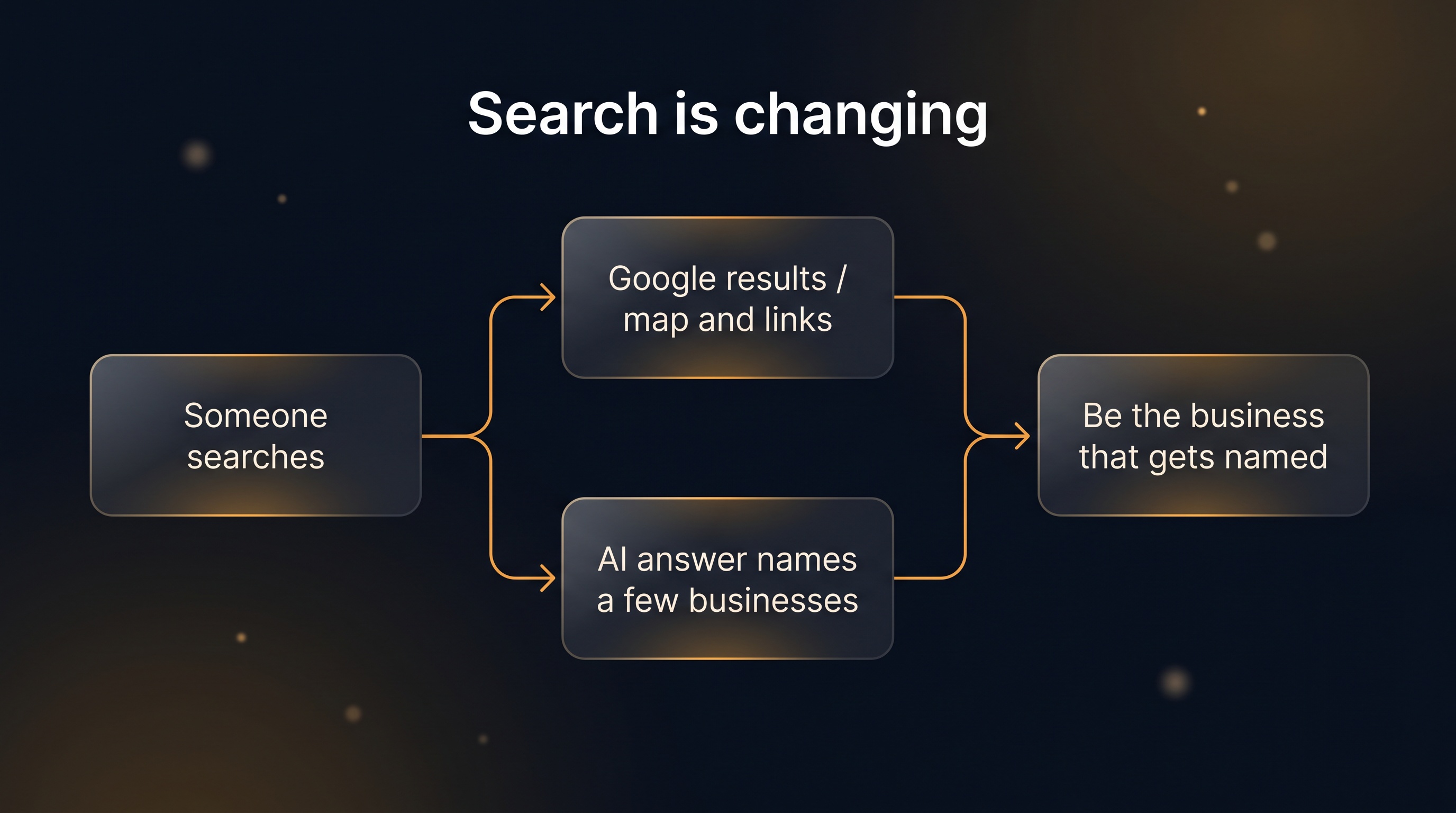
Here's what's changed, and why this guide isn't just "the usual SEO." A large and growing share of people no longer search and scroll — they ask an AI and take the answer.
Google's AI Overviews — the AI-written summary at the top of many searches — reached 2 billion monthly users as of mid-2025 (Alphabet, July 2025). And people are using AI for local decisions specifically: 45% of US consumers used AI tools for local business recommendations in 2026, up from 6% the year before, making AI the third most-used tool behind Google and Facebook (BrightLocal, 2026).
At the same time, fewer searches end in a click to a website at all. SparkToro's research found that in 2024, for every 1,000 US Google searches, only around 360 clicks reached the open web — roughly 58.5% of searches ended without a click (SparkToro / Rand Fishkin). People are getting their answer on the results page or from an AI, and never visiting a site.
That sounds like bad news. It isn't, if you understand the next part. The businesses that get named in those AI answers and result-page summaries still win the work — even when the searcher never clicks through. The goal shifts from "get the click" to "be the answer."
Good news: GEO is still SEO
There's a lot of noise about "GEO" (generative engine optimisation) being a brand-new discipline with its own secret techniques. Google's own position cuts through it.
Google states plainly: you don't need to create new machine-readable files, AI text files, or special markup to appear in AI features. No special structured data, no extra requirements — a page just needs to be indexed and eligible to show with a snippet (Google Search Central, "AI Features and Your Website").
In other words, the work that gets you into AI answers is mostly the same work that gets you ranking normally: be indexed, be clear, be useful. You'll also see people pushing llms.txt — a file you're meant to add so AI engines read your site. As of 2026, the major AI engines don't actually consume it, so it isn't a real edge. Don't burn time on it. The fundamentals in this guide do far more for your AI visibility than any special file ever will.
How to actually get picked up by AI
AI tools don't quote whole pages. They lift short, self-contained passages that cleanly answer a question. So you write for that.
- Front-load the answer. Put the direct answer in the first sentence of a section, then explain. AI extracts the clear, complete passage.
- Use question-style headings and clear structure. Headings, short paragraphs, bullet lists, and plain Q&A formats are easy for an AI to parse and pull from.
- Be specific. Include real facts, numbers, and named details. Vague pages get skipped; concrete ones get quoted.
- Go deep, not shallow. One analysis of around 8,000 AI citations found that 82.5% pointed to deeply nested, content-rich pages — not homepages (Search Engine Land). A thin homepage won't carry you; a genuinely useful answer page will.
- Build off-site mentions. When several independent sources say consistent things about your business, AI treats that as a trustworthy signal.
Notice that none of this is a separate project from your normal SEO. A clear, useful page that answers real questions ranks in Google's normal results and feeds AI answers at the same time. That's the whole point of "GEO is still SEO" — you do the work once and it pays off in both places.
The full playbook for ChatGPT, Google AI, and Perplexity is in How to Show Up in AI Search. And the on-site piece — building a page structured specifically for AI to quote — is in Building an Answers Page AI Will Quote.
8Where schema fits (and where it doesn't)
You'll hear that you need schema markup to rank or to win AI answers. Let's be accurate, because this gets oversold constantly.
Schema is structured code you add to a page to describe what it is — that this is a local business, that this is a review, that this is a list of questions and answers. What it actually does: it makes your page eligible for rich results (the star ratings, FAQ drop-downs, and extra detail you sometimes see in search) and helps machines understand your content.
What it does not do is make you rank higher. Google has been explicit: structured data is "to support search features and not for ranking purposes" (Google Search Central). Treat schema as a clarity and eligibility tool, not a ranking trick. And per Google's AI guidance above, you don't need special schema to appear in AI answers either.
Used well, schema removes ambiguity — which helps both rich results and AI systems read you correctly. That's the right reason to use it. We break it down in plain English in What Is Schema Markup?.
9How to start
If this feels like a lot, don't try to do everything at once. Here's the order that gets you the most ground for the least effort.
- Claim and fully fill out your Google Business Profile. Especially the Services list, in your customers' words. This is free and it's the single highest-leverage step.
- Sort your website basics. Fast, mobile-friendly, one clear page per service, a sensible title, and consistent contact details everywhere.
- Get a steady review habit going. Ask after every good job. Aim for a fresh, recent flow, not a one-off push.
- Add an answers page. A real page that answers the questions customers actually ask, with the answer in the first sentence under each question. This serves normal search and AI search at once.
- Then, and only then, consider location pages — a few genuinely useful ones, never a stack of clones.
Do the first three and you're ahead of most of your local competition. Do all five and you're set up to be found whether someone searches Google or asks an AI. None of it is a one-off — local SEO rewards the businesses that keep the profile current, keep the reviews coming, and keep their pages useful. Steady beats clever.
Key takeaways
- Local search runs on relevance, distance, and prominence. Two of the three are yours to move; distance mostly isn't.
- The service-AREA field is a myth for ranking — but your Services list (what you do) is a real relevance lever. Don't confuse them.
- Reviews do two jobs. Recency and velocity help ranking; volume and rating win the customer once they've found you.
- AI search is now part of the job, not a side quest. With AI Overviews at 2 billion users and 45% of consumers using AI for local recommendations, being quotable matters.
- GEO is still SEO. Google says no special files, markup, or schema are needed for AI features — be indexed, clear, and useful.
- Schema is for eligibility and clarity, not ranking. Use it to help machines understand you, not as a shortcut to the top.
Common questions
What's the single most important thing for a local business to do first?
Claim and fully complete your Google Business Profile, and fill out the Services list in the words your customers actually use. It's free, it's fast, and it directly feeds the relevance Google uses to rank you.
Does listing more service areas help me rank in those areas?
No. The service-area field tells customers where you'll travel, but it isn't a ranking lever for the map box — that's driven mostly by how close you are to the searcher. To improve relevance, work on your Services list and your website content instead.
Do I need to do something special to show up in AI search like ChatGPT or Google's AI?
Mostly no. Google itself says you don't need special files, markup, or schema for its AI features — normal good SEO plus being indexed is what matters. The extra step that helps is structuring your content as clear questions with the answer in the first sentence, so AI can lift it.
Is schema markup required to rank?
No. Schema makes your pages eligible for rich results and helps machines understand your content, but Google has confirmed it's not a ranking factor. It's worth doing for clarity, just don't expect it to push you up the rankings on its own.
More reviews or more recent reviews — which matters more?
For ranking, recency and velocity tend to matter more than raw count — a steady recent flow beats a big stale pile. For winning the customer, both rating and freshness count, since most people only use businesses rated 4 stars or higher and want to see reviews from the last few months.
Related articles
Want to see how you stack up against the businesses already winning your local searches — on Google and in AI answers?
Get a free competitor snapshot — we show you where rivals show up online and where the gaps are.
Get your free snapshot→