
You know your marketing needs to be more consistent, and you're stuck between two paths: set up automation yourself, or pay an agency to handle it. We get this question a lot, and the honest answer is that it's not one-versus-the-other — it depends on what's actually eating your time. The short version: if your problem is missed follow-ups and repetitive admin, automation you set up once fixes it cheaply. If your problem is strategy, creative, and channels you don't understand, an agency earns its fee. Here's how to tell which is you.
1First, get clear on what each one actually is
These two solve different problems, and confusing them is where money gets wasted.
Marketing automation is software that does repetitive tasks for you — instant replies to enquiries, scheduled follow-up emails, review requests, lead-source tracking. You set the rules once, and it runs. It's a tool you own.
An agency is people you pay to do the thinking and the doing — strategy, ad creative, running campaigns across channels, ongoing management. It's expertise and labour you rent.
One is a system. The other is a team. You can have either, both, or neither.
2What automation actually costs
The DIY path is cheaper than most owners expect, because the tools are cheap and the work is one-time.
A CRM with automation runs $0 to start and roughly $14–45 a month for a small business, billed annually in USD (see what a CRM actually costs for the full breakdown). On top of the subscription, the cost is your time: a focused afternoon to connect a form, write your follow-up emails, and set the rules.
The reason it's worth it: reps spend only 28% of their week actually selling — the rest is admin, data entry, and chasing information (Salesforce State of Sales, 2023). Automation takes the most repetitive slice of that off your plate permanently. You pay the setup cost once and the monthly fee is small.
3What an agency actually costs
This is where the numbers jump, and where honesty matters.
Agency retainers for small businesses commonly land around $1,000–$3,000 a month for single-channel work and roughly $3,500–$10,000 a month for multi-channel management. Treat those as typical ranges from the industry, not survey-grade figures — real quotes vary widely by scope and market.
It's worth comparing that to hiring in-house too. The median wage for a marketing manager in the US was $161,030 in May 2024 (US Bureau of Labor Statistics) — before tools, benefits, and overhead. For most small local businesses, a full-time hire isn't on the table, which is exactly why the agency-versus-DIY question comes up.
4When automation (DIY) is the right call
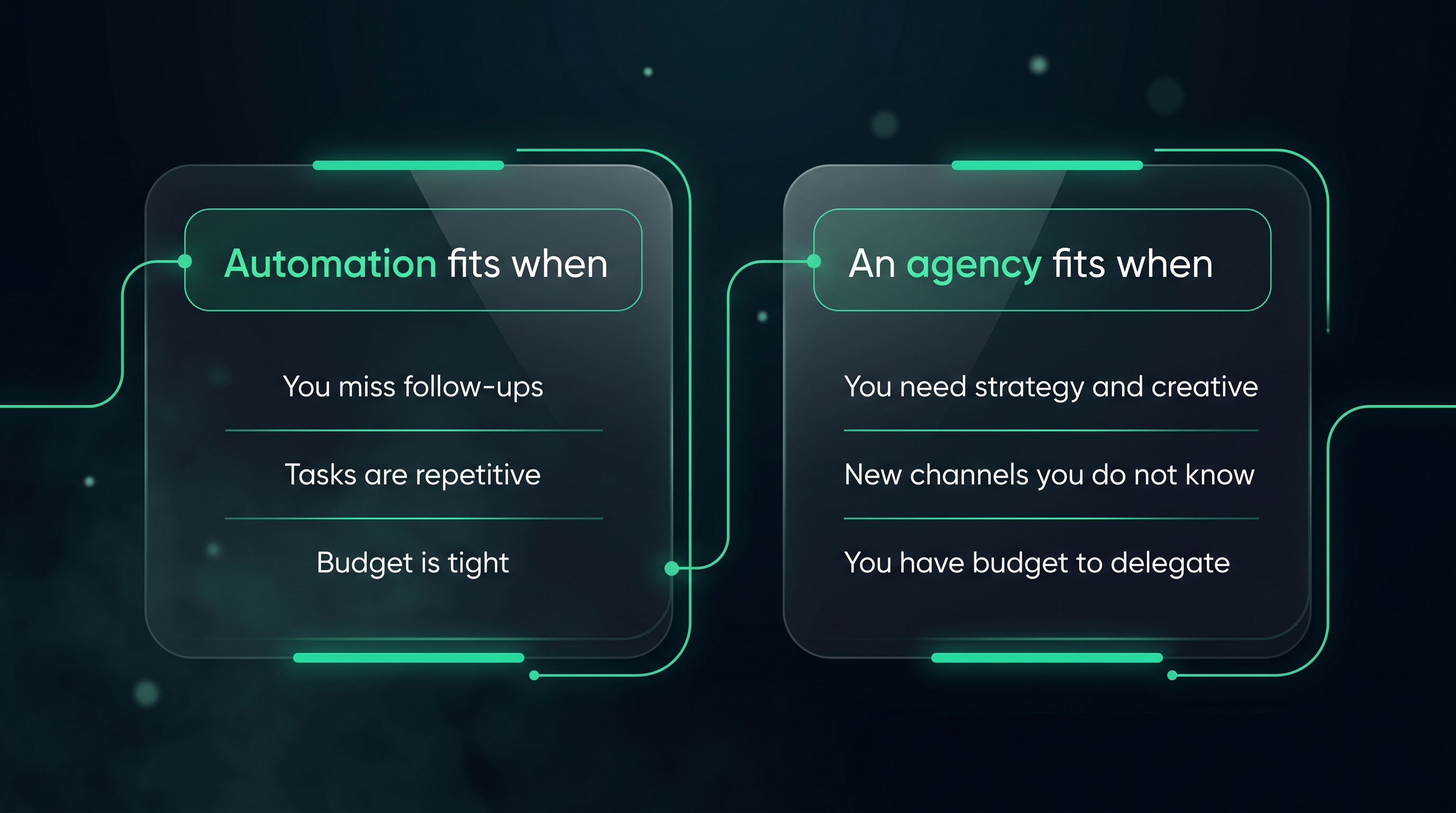
Automation wins when your problem is repetition, not strategy.
- Your leads come in but nobody chases them. This is the classic case. A follow-up sequence fixes it for the price of a subscription.
- You know what works — you just can't keep up with it. If you already get enquiries from Google, referrals, or ads, you don't need someone to find customers. You need to stop dropping the ones you have.
- Your budget is tight. $14–45 a month versus four figures is not a close call when the task is repetitive admin.
- You want to own the system. Set it up once and it keeps working whether or not you're paying anyone.
At Bare Bayside Labs, we see this in nearly every business we audit — the leads are already arriving, but the follow-up is the leak. That's an automation problem, not an agency problem.
5When an agency is the right call
An agency earns its retainer when the work needs skill and time you don't have.
- You don't know which channels to use, or your ads aren't working. Diagnosing and fixing paid campaigns is genuine expertise.
- You need creative regularly. Ongoing ad design, video, and copy is a real workload an agency can carry.
- You're ready to grow and the marketing work is now a full job. When marketing is more than you can do alongside running the business, renting a team is cheaper and faster than building one.
- You've already automated the basics and want to scale demand. Agencies add the most value on top of a working system, not instead of one.
6Side-by-side
| Marketing automation (DIY) | Hiring an agency | |
|---|---|---|
| What it is | Software that runs repetitive tasks | People who do strategy + execution |
| Typical cost | $0 to start; ~$14–45/mo (USD, annual) | ~$1,000–$3,000/mo single-channel; ~$3,500–$10,000/mo multi-channel (ranges) |
| Best for | Follow-ups, reminders, tracking, admin | Strategy, ad creative, channel management |
| Effort from you | One-time setup, then runs itself | Briefing, reviewing, approving |
| Who owns it | You — keeps working without ongoing fees | The agency — stops when you stop paying |
| Solves | Dropped leads, repetitive work | "What should we do and who'll do it?" |
7What we recommend
Start with automation — almost always.
The repetitive leaks are the cheapest to fix and the most damaging to leave open. Most small businesses don't have a strategy problem; they have a follow-up problem. Automate the basics first: instant lead reply, a follow-up sequence, review requests, and lead-source tracking. That's a one-afternoon, $14–45-a-month fix.
Then, if you still need help with strategy, creative, or channels you don't understand, bring in an agency — on top of a working system, not instead of one. An agency feeding leads into a business that drops them is paying to fill a leaking bucket. Plug the leak first.
For the full picture of what automation covers and what it costs, see Marketing Automation for Small Business.
Key takeaways
- They solve different problems. Automation handles repetitive admin; an agency handles strategy, creative, and channel management. Confusing the two wastes money.
- Automation is cheap and one-time. $0 to start, $14–45/mo for a small business, plus an afternoon of setup.
- Agencies cost four figures a month. Roughly $1,000–$3,000 single-channel and $3,500–$10,000 multi-channel as typical ranges — a serious commitment.
- A full in-house hire is rarely realistic. The US median marketing-manager wage was $161,030 in 2024 (BLS), before overhead — which is why the DIY-versus-agency question exists at all.
- Most small businesses have a follow-up problem, not a strategy problem. Reps spend only 28% of their week selling (Salesforce, 2023); automation reclaims the rest.
- Start with automation, add an agency later — on top of a working system, never to fill a leaking bucket.
Common questions
Is it cheaper to automate or hire an agency?
Automation, by a wide margin, for the repetitive work most small businesses struggle with. A CRM with automation costs $0 to start and $14–45/mo; agency retainers commonly run $1,000–$3,000/mo single-channel and more for multi-channel. They're not really competing, though — agencies handle strategy and creative, automation handles admin.
Can I do both?
Yes, and that's often the best setup. Automate the basics yourself so leads stop falling through the cracks, then use an agency for the work that needs real expertise — strategy, ad creative, channel management. The agency adds more value sitting on top of a system that already captures and follows up every lead.
When does an agency actually make sense?
When the problem is skill or capacity, not repetition — your ads aren't working, you need regular creative, or marketing has become a full job you can't fit around running the business. If the problem is just that nobody's following up with leads, that's an automation fix, not an agency one.
Why not just hire someone in-house?
For most small local businesses, the cost makes it impractical. The median US marketing-manager wage was $161,030 in 2024 (BLS), before tools and overhead. That's why the realistic choice is usually between DIY automation and renting an agency's time.
What should I do first?
Plug the leaks. Set up instant lead replies, a follow-up sequence, review requests, and lead-source tracking. It's an afternoon of work and a small monthly fee, and it fixes the most common and most expensive problem — leads coming in and nobody chasing them. Add an agency afterwards if you still need help finding more demand.
Related articles
Want to see whether your problem is a leaking funnel or a demand problem before you spend a cent?
Get a free competitor snapshot — we show you where rivals show up online and where the gaps are.
Get your free snapshot→